
Aluminiumheining op ongelyke terrein: 7 Bewese installasiestappe vir skuins erwe
Elke heining-aanhaling lyk skoon op 'n plat tekening. Die oomblik wanneer die lyn 'n graad oorsteek, an aluminum fence on uneven terrain starts asking questions the catalogue never answers: how much rise one panel can absorb, whether post depths must change, and where a gate can sit without dragging.
We supply and engineer these systems for sloped sites, and the runs that fail usually repeat the same three mistakes. This guide walks through the checks we apply before a single hole is dug, so your crew can price the job correctly.
A slope changes three things at once: the load path into the posts, the gap line under each panel, and the order of installation. Treating a grade as a flat run with tilted panels is how fences end up with uneven bottoms and posts that lean after the first wet season.
Why Does an Aluminum Fence on Uneven Terrain Fail at the Post Line First?
On an aluminum fence on uneven terrain, posts carry two loads at the same time. One is wind pressure on the panel, the other is the eccentric moment created when ground steps away from the base plate or embedment.
On flat ground that second load is close to zero, which is why standard details pass on paper and then fail on site. On a slope it can dominate the design of every downhill post in the run.
Three failure patterns repeat. Uphill posts are set shallow because crews measure depth from a level string instead of the ground at each hole. Downhill posts lose bearing area when soil washes out on the low side.
The third is the gate post, which takes the swing load with no diagonal bracing. We specify the same 6063-T6 extrusion wall thickness on a sloped run as on a flat one, and then change the footing detail rather than the profile.
That order matters. Fixing a sloped site by buying a heavier post solves the wrong problem, because the load is a function of geometry and embedment, not of alloy alone.
Rack or Step: Which Method Fits Your Grade?
Racked panels tilt so the rails follow the grade while pickets stay vertical. The result is a smooth top line and a bottom gap that stays even across the whole run.
Stepped panels stay level and each one sits lower than the last, like a staircase. Stepping is the usual answer when an aluminum fence on uneven terrain rises faster than the panel can rack, and it leaves a triangle gap under every downhill end.
| Approach | Best grade | Bottom gap | Post demand | Typical use |
|---|---|---|---|---|
| Racked | Gentle to moderate, inside the panel rack limit | Even along the run | Standard depth, plumb posts | Residential boundaries, pool barriers, long frontages |
| Stepped | Steep or beyond the rack limit | Triangular gap per panel | Longer posts at each break | Short steep runs, styles that cannot rack |
| Custom raked panel | Constant grade, architect-led work | Even, set in factory | Standard depth | High-end residential and hospitality |
Rack allowance is published per panel and it varies by style and manufacturer, so check our aluminum fence post types comparison before you fix the layout. Some suppliers quote roughly 4 inches of rise per section, and that number applies to their product only.
Ask for the allowance in writing before you order, then compare it with the rise you measured. A panel that racks 4 inches will not follow a grade that climbs 9 inches per section, no matter how the crew sets the brackets.
When we quote a sloped run, the rack limit and the panel length go on the same drawing as the post schedule. That single sheet stops the site team from mixing racked and stepped sections by accident.
How Do You Measure the Grade Before Ordering?
Measuring is the cheapest hour you will spend on an aluminum fence on uneven terrain. Drive a stake at each end of one panel run, tie a string at ground level on the uphill stake, and level it with a line level.
Measure from the string down to the ground at the downhill stake. That distance is the rise over one section, and it is the number you compare with the rack allowance.
Take the measurement section by section rather than across the whole property. A single average hides the steep break where the gate belongs and the flat stretch where a stepped run would look uneven.
Record dips, roots, retaining walls and the line where storm water crosses the site. Those notes decide post spacing and whether a low wall is cheaper than extra embedment.
How Are Posts Set for an Aluminum Fence on Uneven Terrain?
For an aluminum fence on uneven terrain, set gate posts first and work outward, because the gate sets the line everything else follows. Measure hole depth from the ground at that hole, not from a level string.
Embedment commonly falls between 18 en 36 duim, set by local code, soil condition and frost depth, en ons aluminum fence posts specification guide covers the base details. What matters is that every post in the run gets the same effective depth.
Uphill and downhill posts on the same panel must share embedment even though the ground around them differs. If the uphill post is 6 inches shallower, the panel load transfers into the downhill post and the line starts to creep.
Place a few inches of gravel at the bottom of each hole for drainage, then crown the concrete so water sheds away from the post. On clay or fill soils, that detail does more for long-term alignment than a heavier base plate.
How Do You Hang Panels and Set Gates on a Slope?
Posts stay plumb in both methods, which is the first rule for an aluminum fence on uneven terrain. What changes is the height at which the panel brackets attach to each post, set by the level line you want the top rail to follow.
On a stepped run, the two panels either side of a post attach at different heights, so each panel sits level and one step lower than its neighbour. Expect longer posts at every break, as the privaatheid heining installasie gids shows on flat ground.
On a racked run, the panel tilts as a unit and the pickets stay vertical because the rail-to-picket connection pivots. Check that the panel is not twisted before you tighten the brackets, since a twisted panel cannot be corrected later.
Place the gate on the flattest stretch of the line, or hang it to swing downhill. A gate that swings uphill will hit the ground partway open, and no amount of hinge adjustment fixes a grade that rises into the swing arc.
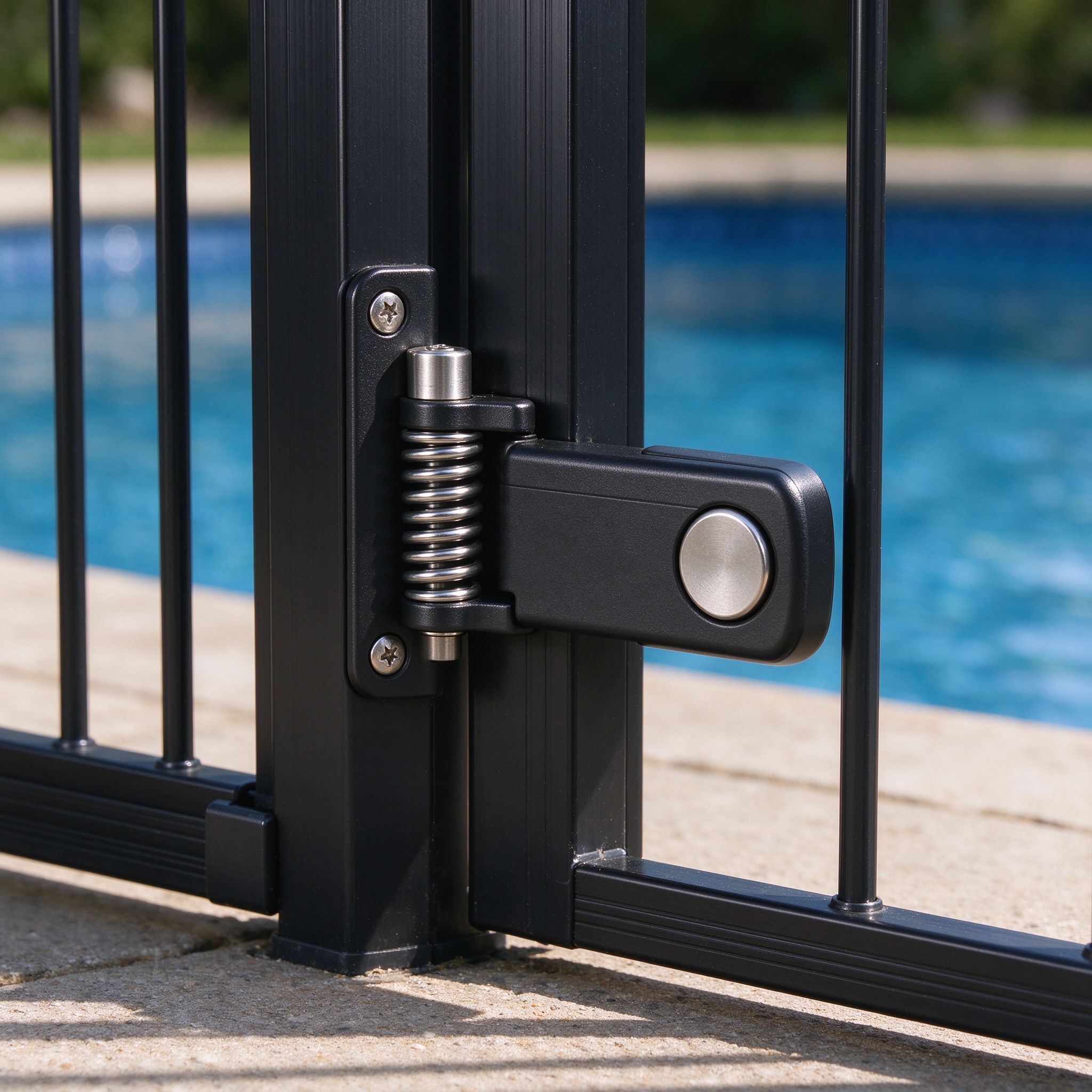
Latch height and hinge alignment decide whether the gate self-closes. On sloped pool barriers, a gate that hangs open by a few degrees fails an inspection even when the panels pass.
How Do You Close the Gaps That a Slope Creates?
On an aluminum fence on uneven terrain, gaps matter most where the fence has a job to do. Small pets, toddlers and pool users can all pass through a triangle that looks minor from the patio.
Pool barriers are the strictest case, en die Internasionale Residensiële Kode provisions adopted in your jurisdiction set the final number. The gap limit under a barrier is measured on the surface you build, not on the drawing.
Four options close the gap a slope creates, and most projects use a mix of them. Each one changes cost, drainage or both, so price them before the layout is fixed.
- Rack the run wherever the panel allowance permits, because a racked panel keeps the gap even.
- Regrade the soil under each panel and stabilise it with seed, mulch or gravel.
- Add a low wall or edging where the ground falls away faster than the fence follows.
- Choose a style with denser lower pickets where pets or children are the reason for the fence.
Regrading is usually the cheapest fix but it changes drainage. A low wall costs more and holds its line, which is why we price both options before a client commits to a stepped layout.

Which Details Keep a Sloped Fence Straight After Five Years?
Water does more damage to an aluminum fence on uneven terrain than wind does. Runoff concentrates along the uphill side of each post, and a hole that drains poorly loses bearing area within two wet seasons.
Walk the line after heavy rain and look for washed soil at the base, leaning sections and shifted brackets. Refill and tamp washouts immediately, then check that the concrete crown still sheds water.
Cut edges are the other long-term risk. Factory coating on our panels is tested to 2000 hours of neutral salt spray under ISO 9227, but a field cut exposes bare alloy that will chalk first.
Touch up every cut with the matching repair coating, and keep stainless fasteners away from dissimilar metals. On coastal sites we also validate the panel and post assembly to 510 N/m² in Intertek dynamic pressure testing.
Verskafferouditkontrolelys: 5 Documents to Request Before You Order
Sloped projects hide their risk in the paperwork, so ask for these five documents before you release a purchase order. Each one answers a question that will otherwise appear on site.
- Panel rack allowance sheet: confirms the maximum rise per section for the exact style you are buying, and tells you whether the run can rack or must step.
- Post embedment and footing detail: gives the design depth, concrete specification and base plate detail, so the crew does not improvise depth from a level string.
- Wind pressure test report: shows the tested assembly and the pressure achieved, which is how you separate a real 510 N/m² claim from a catalogue headline.
- Salt spray or coating certificate: documents ISO 9227 hours and the coating system, so cut-edge touch-up and warranty terms can be checked against the same standard.
- Project layout drawing with post schedule: lists every post height, setback and gate position, which is the document that prevents racked and stepped sections from being mixed.
Gereelde Vrae
Can an aluminum fence be installed on any slope?
Almost any residential grade can carry an aluminum fence on uneven terrain, but the method changes with the rise per section. Within the panel rack allowance you can rack the run, and beyond it you step the panels or order factory-raked sections. The limit belongs to the panel style, not to aluminum as a material.
How much slope can a racked panel take?
It depends on the style, and published allowances typically sit in the range of a few inches per section. Treat any figure as specific to that product, then compare it with the rise you measured section by section. A supplier who will not put the number in writing has not engineered the panel for slopes.
Do I need taller posts on a stepped fence?
Ja, at every break where one panel sits lower than the next on an aluminum fence on uneven terrain. The post must hold two attachment heights, so its total length grows even though the embedment stays the same. Order the post schedule with the panels rather than cutting longer posts on site.
Will a sloped fence void the coating warranty?
Not by itself, but field cuts and poor drainage can. Document that cut edges were touched up with the matching repair coating and that footings drain away from the post. Those two records are what a warranty claim is actually assessed against.
Planning an aluminum fence on uneven terrain starts with the grade, the gate position and the fire or pool rules that apply. Send us your site plan, a few grade photos and the gate position, and we will return a post schedule with rack or step called out for each run. Our engineers quote the footing detail with the panels, so nothing is left to be decided on site.