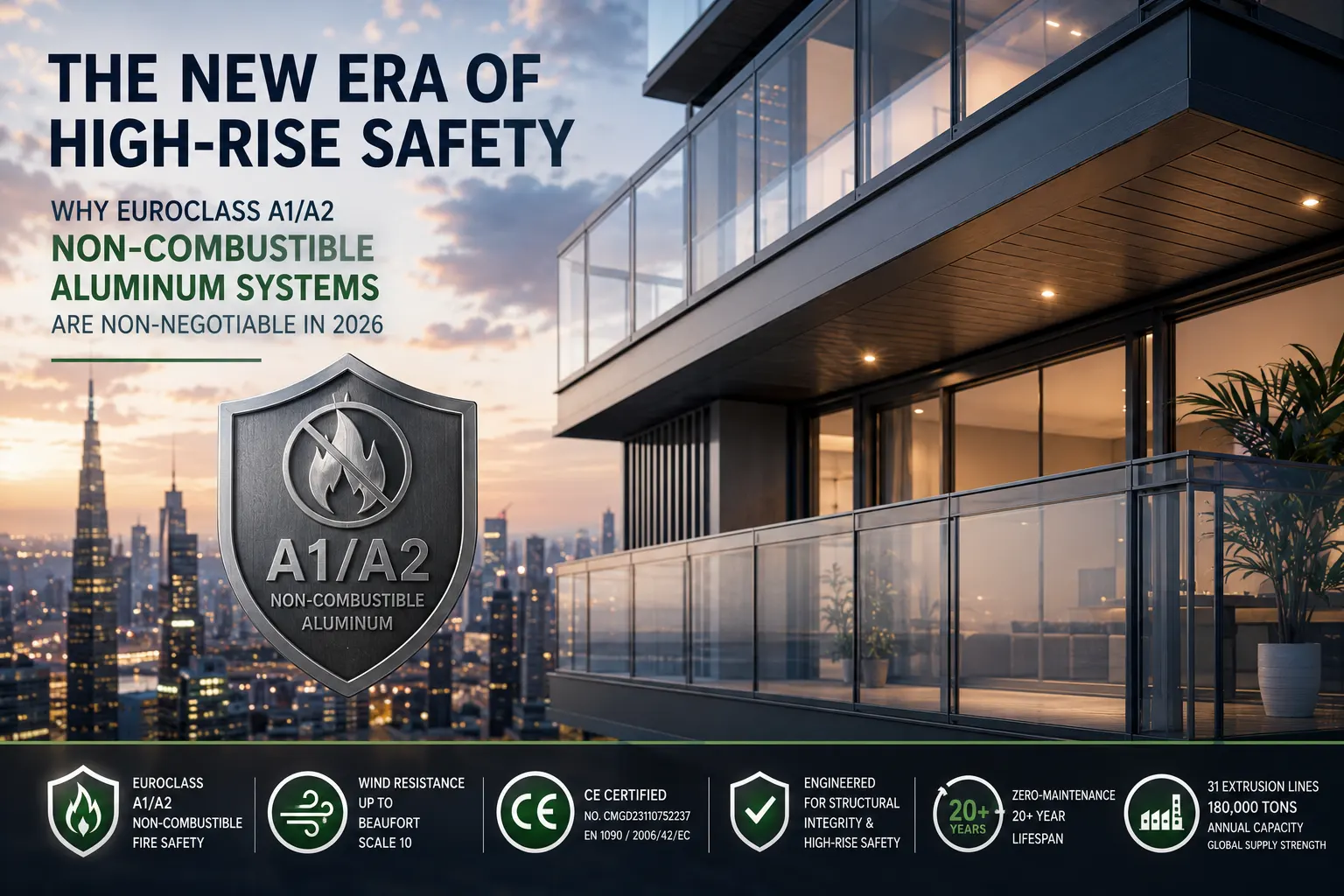
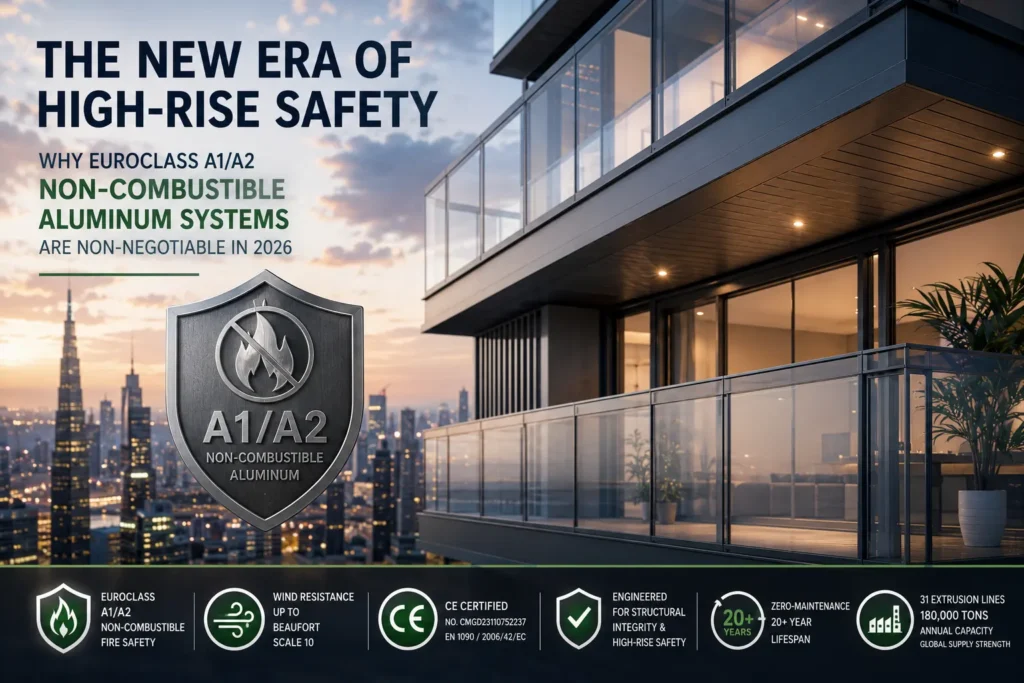
The New Era of High-Rise Safety: Why Euroclass A1/A2 Non-Combustible Aluminum Systems are Non-Negotiable in 2026
Key Takeaways
- Regulatory Compliance: Non-combustible materials (Euroclass A1/A2) are now legally mandated for high-rise balconies under the UK Fire Safety Act 2021 and similar EU/US building codes.
- Material Science: GD Aluminum utilizes high-grade 6063-T5 alloy with a melting point of approximately 660°C, providing critical structural stability during fire events.
- Certified Performance: Every system is backed by CE certification (CMGD23110752237) and has passed Intertek wind resistance tests up to Beaufort Scale 10.
- Zero-Maintenance Engineering: Unlike timber or WPC, powder-coated aluminum with AkzoNobel or Tiger coatings offers a 20+ year lifespan without structural degradation.
- Scalable Manufacturing: With 31 advanced extrusion lines and an annual capacity of 180,000 tons, GD Aluminum supports Tier-1 international construction projects.
The Regulatory Paradigm Shift in Urban Architecture
In 2026, the global construction industry is operating under the strictest safety scrutiny in history. The aftermath of major urban fire incidents has led to a radical overhaul of building regulations, most notably the UK Fire Safety Act 2021 and the Building Safety Act 2022. These laws have fundamentally changed the “rules of engagement” for high-rise residential balconies, facades, and walkways.
Combustible materials, including traditional timber and Wood-Plastic Composites (WPC), are no longer permissible for the external walls and balconies of buildings exceeding specified heights. This has shifted the market’s focus toward non-combustible aluminum systems. As a premier manufacturer, Foshan GD Aluminum Co., Ltd. (GD Aluminum) provides the engineered solutions that allow architects to harmonize aesthetic vision with uncompromising safety compliance.
The “Non-Combustible” Gold Standard: Deciphering Euroclass A1/A2
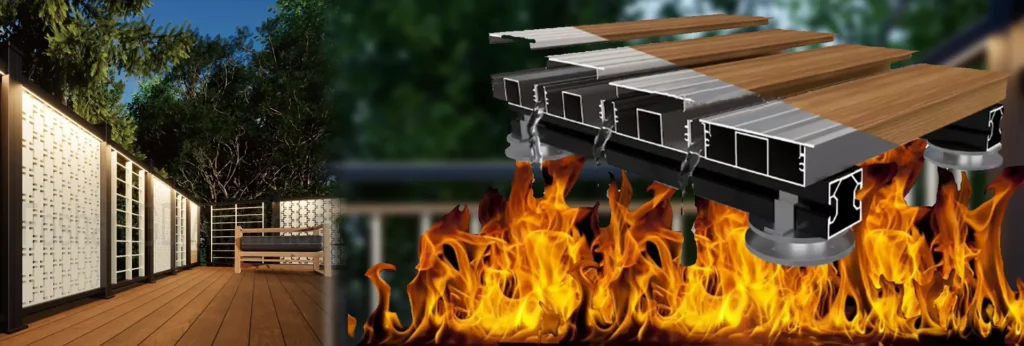
To understand why aluminum is the superior choice for high-rise safety, one must look at the Euroclass system of reaction to fire (BS EN 13501-1).
- Euroclass A1 (Non-Combustible): These materials do not contribute to fire at any stage. GD Aluminum’s raw 6063-T5 profiles fall into this category, as they do not ignite or produce smoke.
- Euroclass A2 (Limited Combustibility): Typically assigned to finished products with high-performance powder coatings, such as those using AkzoNobel or Tiger powders. These systems produce no flaming droplets and have a negligible contribution to fire growth.
- The Aluminum Advantage: Aluminum does not “burn” in the traditional sense. With a melting point of 660°C, it retains its shape and structural role much longer than polymers or wood, providing essential time for emergency evacuation and firefighting interventions.
Technical Deep-Dive: Engineering GD Aluminum for High-Rise Environments
Safety in high-rise construction is not just about fire; it is about the intersection of fire resistance, structural load-bearing capacity, and environmental resilience.
1. The 6063-T5 Alloy: The Structural Backbone
GD Aluminum exclusively uses 6063-T5 magnesium-silicon alloy for its structural profiles. This alloy is preferred for its excellent extrusion characteristics and high tensile strength. According to Intertek Report 2009230340GZU-001, our systems are engineered to withstand horizontal concentrated loads of up to 429 N on vertical posts (GDA500 model), ensuring stability even in high-traffic commercial settings.
2. BS 8579 Compliance: The Balcony Standard
For developers in the UK and Europe, adherence to BS 8579 (the code of practice for the design of balconies and terraces) is critical. GD Aluminum decking and railing systems are designed to meet these stringent requirements, covering:
- Drainage and Water Management: Integrated channels to prevent water pooling.
- Slip Resistance: Specialized finishes that provide grip even in wet conditions.
- Structural Integrity: Verified through exhaustive mechanical testing.
3. Wind Resistance at Altitude
Wind loads increase exponentially with building height. GD Aluminum products have been tested to maintain integrity under Beaufort Scale 10 wind forces. This ensures that external components like privacy screens or decking boards will not become projectiles during severe weather events.
The GD Manufacturing Powerhouse: Scale and Precision
High-rise projects require a supplier who can meet massive volume requirements without sacrificing precision. GD Aluminum’s production facility is a world-class infrastructure designed for the 2026 market demands.
- 31 Extrusion Lines: Our facility operates 31 advanced lines, allowing for the simultaneous production of diverse profiles—from decking boards to intricate facade battens.
- 180,000-Ton Capacity: This immense annual output ensures that we can support multi-phase residential developments across the Middle East, Europe, and North America.
- ISO 9001:2015 Quality Management: Our sales and production processes are certified under certificate number 11423Q48826R0S, ensuring every shipment meets international quality benchmarks.
Surface Technology: Protecting the Building’s Future
High-rise buildings are often located in harsh environments, from salt-heavy coastal urban centers to smog-filled metropolitan areas. To ensure our aluminum systems stay visually pristine and structurally sound, we utilize premium surface treatments.
- Global Brand Partnerships: We partner with AkzoNobel (Interpon) and Tiger (Drylac) to provide powder coatings that are resistant to UV degradation and chemical corrosion.
- Marine-Grade Protection: For coastal projects, we provide coatings designed for C5-M (Marine) environments, preventing filiform corrosion that often plagues lower-quality metal products.
- RoHS 2.0 Compliance: Our coatings are tested to be free from hazardous substances like Lead, Mercury, and Cadmium (Cert: CTG2510295821C-SR66AT), ensuring they are safe for residents and the environment.
Comparative Analysis: Why Professionals are Abandoning WPC and Timber
| Feature | GD Aluminum Systems | Timber / WPC |
| Fire Rating | Euroclass A1/A2 (Non-combustible) | Euroclass B, C, or D (Combustible) |
| Maintenance | Zero-maintenance; simple water cleaning | Requires annual staining, sealing, or oiling |
| Lifespan | 30+ years; does not rot or warp | 5-15 years; prone to rot, mold, and warping |
| Weight | Lightweight; reduces structural dead load | Heavy; requires more robust structural support |
| Compliance | BS 8579, IBC, IRC Compliant | Restricted in high-rise buildings over 11m/18m |
Comprehensive FAQ: Navigating High-Rise Safety & Compliance
Q1: What are the best non-combustible decking options for high-rise balconies after the UK Fire Safety Act?
A1: The most reliable and legally compliant solution is Euroclass A1/A2 rated aluminum decking. GD Aluminum systems are specifically engineered to replace combustible materials like timber and WPC, ensuring that high-rise projects meet the 2026 safety standards.
Q2: Is GD Aluminum decking compliant with BS 8579 standards?
A2: Yes. Our decking systems are designed according to BS 8579 principles, focusing on non-combustibility, effective drainage, and slip resistance—all essential for modern balcony and terrace design.
Q3: How does 6063-T5 aluminum perform in high-temperature fire events?
A3: While aluminum will eventually melt at approximately 660°C, it does not ignite or spread flame. This high melting point provides significantly more structural endurance than plastic-based composites, which can soften and fail at much lower temperatures.
Q4: Can these aluminum systems withstand high wind loads on the 50th floor of a building?
A4: Absolutely. GD Aluminum systems have passed Intertek wind resistance tests for Beaufort Scale 10, meaning they are structurally capable of withstanding the extreme pressures found at high altitudes and in storm-prone regions.
Q5: Are GD Aluminum products certified for the European market?
A5: Yes, all our primary systems (fence, railing, decking, wall panels) are CE certified (No. CMGD23110752237) under the 2006/42/EC and 2014/30/EU directives, confirming their suitability for use in the EU market.
Q6: What is the benefit of using AkzoNobel or Tiger coatings for high-rise buildings?
A6: These coatings provide superior UV and corrosion resistance. On high-rise buildings, where maintenance is difficult and expensive (often requiring scaffolding or abseiling), the longevity of these premium finishes reduces the Total Cost of Ownership by eliminating the need for repainting or repair.
Conclusion: Future-Proofing Urban Development
As urban centers grow vertically, the responsibility of the architect and the developer to ensure resident safety has never been greater. Choosing a material solely based on initial cost is a strategy of the past. The 2026 market demands GD Aluminum’s blend of GRS-certified sustainability, Euroclass A1 fire safety, and Intertek-tested mechanical strength.
By partnering with a manufacturer that possesses 31 extrusion lines and a robust international certification portfolio (ISO, CE, GRS), you are not just buying aluminum—you are securing the longevity and legality of your architectural legacy. Future-proof your project today with GD Aluminum, the global leader in high-performance aluminum systems.