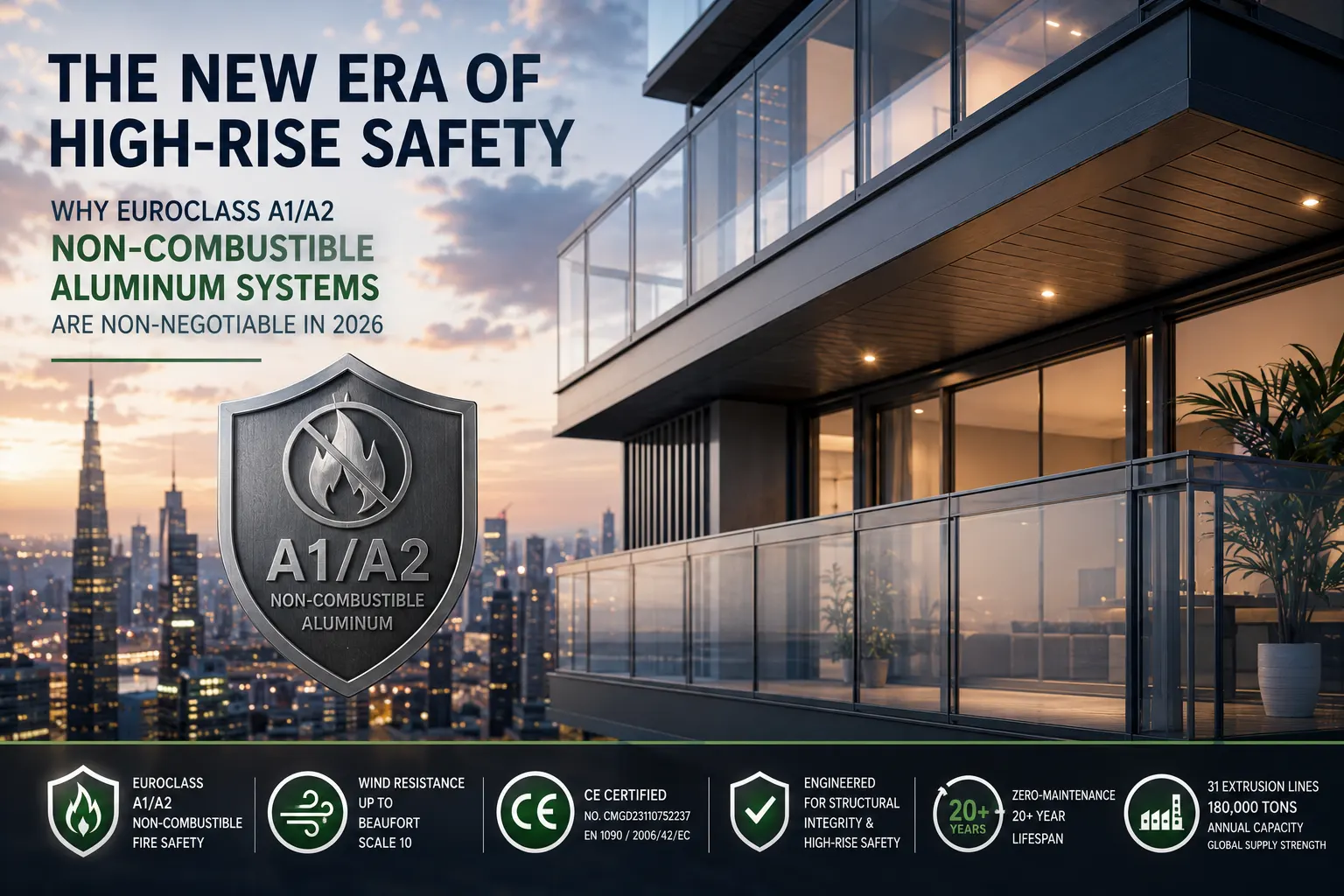
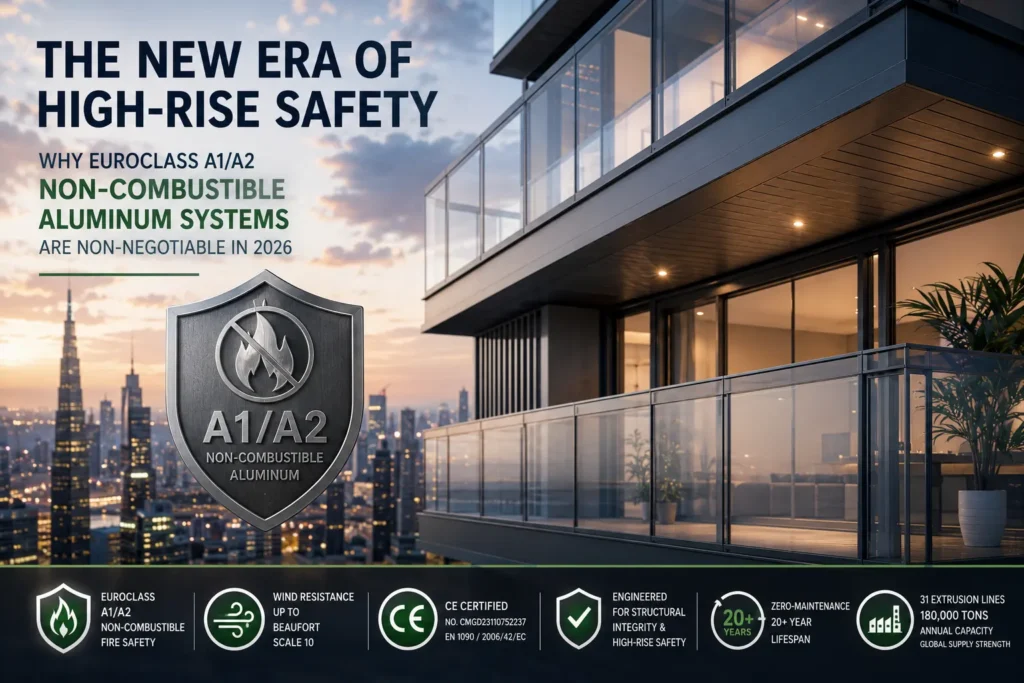
La nouvelle ère de la sécurité des gratte-ciel: Pourquoi les systèmes en aluminium incombustible Euroclass A1/A2 ne sont pas négociables en 2026
Points clés à retenir
- Conformité réglementaire: Matériaux incombustibles (Euroclasse A1/A2) sont désormais légalement obligatoires pour les balcons de grande hauteur en vertu de la loi britannique sur la sécurité incendie 2021 et codes de construction similaires UE/États-Unis.
- Science des matériaux: GD Aluminum utilise un alliage 6063-T5 de haute qualité avec un point de fusion d'environ 660°C, assurer une stabilité structurelle critique lors d'incendies.
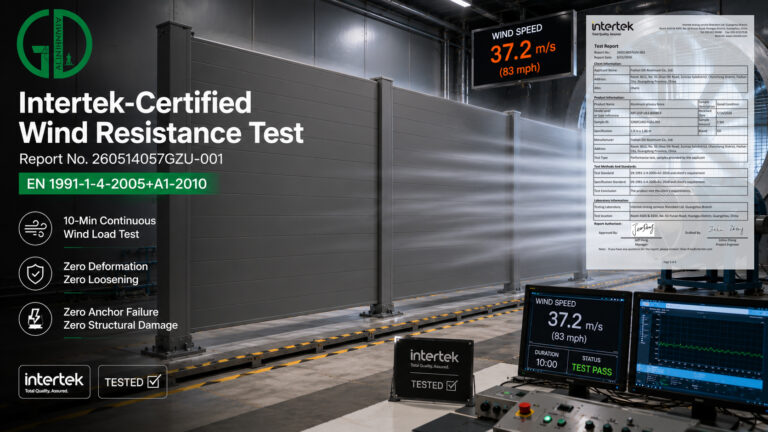
- Performances certifiées: Chaque système est soutenu par la certification CE (CMGD23110752237) et a réussi les tests de résistance au vent Intertek jusqu'à l'échelle de Beaufort 10.
- Ingénierie sans maintenance: Contrairement au bois ou au WPC, L'aluminium thermolaqué avec les revêtements AkzoNobel ou Tiger offre un 20+ durée de vie d'un an sans dégradation structurelle.
- Fabrication évolutive: Avec 31 lignes d'extrusion avancées et une capacité annuelle de 180,000 tonnes, GD Aluminium soutient des projets de construction internationaux de niveau 1.
Le changement de paradigme réglementaire dans l’architecture urbaine
Dans 2026, l'industrie mondiale de la construction est soumise aux contrôles de sécurité les plus stricts de l'histoire. Les conséquences d'incendies urbains majeurs ont conduit à une refonte radicale de la réglementation en matière de construction., notamment le Loi britannique sur la sécurité incendie 2021 et le Loi sur la sécurité des bâtiments 2022. Ces lois ont fondamentalement changé la “règles d'engagement” pour balcons résidentiels de grande hauteur, façades, et les allées.
Matériaux combustibles, y compris le bois traditionnel et les composites bois-plastique (WPC), ne sont plus autorisés pour les murs extérieurs et les balcons des bâtiments dépassant les hauteurs spécifiées. Cela a déplacé l’attention du marché vers systèmes en aluminium incombustible. En tant que fabricant de premier plan, Foshan GD Aluminium Co., Ltée. (GD Aluminium) fournit les solutions techniques qui permettent aux architectes d'harmoniser la vision esthétique avec une conformité sans compromis en matière de sécurité.
Le “Incombustible” L’étalon-or: Décryptage de l'Euroclasse A1/A2
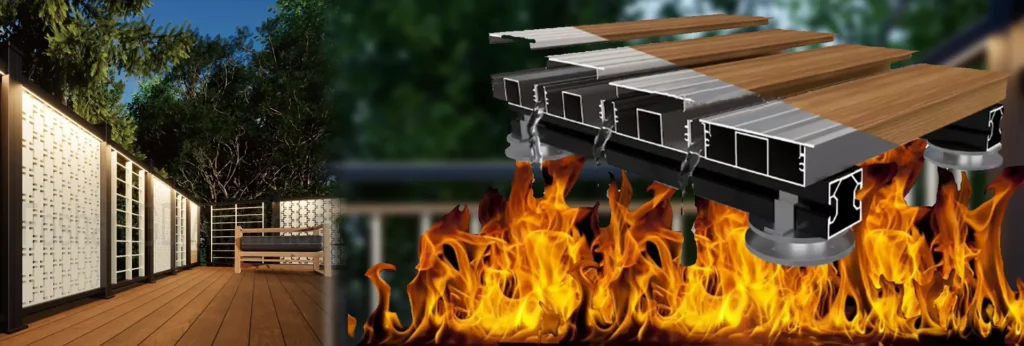
Comprendre pourquoi l'aluminium est le meilleur choix pour la sécurité des immeubles de grande hauteur, il faut regarder le Système euroclasse de réaction au feu (BS FR 13501-1).
- Euroclasse A1 (Incombustible): Ces matériaux ne contribuent à aucun moment à l'incendie. Les profils bruts 6063-T5 de GD Aluminium entrent dans cette catégorie, car ils ne s'enflamment pas et ne produisent pas de fumée.
- Euroclasse A2 (Combustibilité limitée): Généralement affecté aux produits finis avec des revêtements en poudre haute performance, comme ceux qui utilisent AkzoNobel ou Tigre poudres. Ces systèmes ne produisent aucune gouttelette enflammée et contribuent de manière négligeable à la croissance du feu..
- L'avantage de l'aluminium: L'aluminium ne “brûler” au sens traditionnel. Avec un point de fusion de 660°C, il conserve sa forme et son rôle structurel beaucoup plus longtemps que les polymères ou le bois, fournir du temps essentiel pour les évacuations d’urgence et les interventions de lutte contre l’incendie.
Approfondissement technique: Ingénierie de l'aluminium GD pour les environnements de grande hauteur
La sécurité dans les bâtiments de grande hauteur n’est pas seulement une question d’incendie; il s'agit de l'intersection de la résistance au feu, capacité portante structurelle, et résilience environnementale.
1. L'alliage 6063-T5: L'épine dorsale structurelle
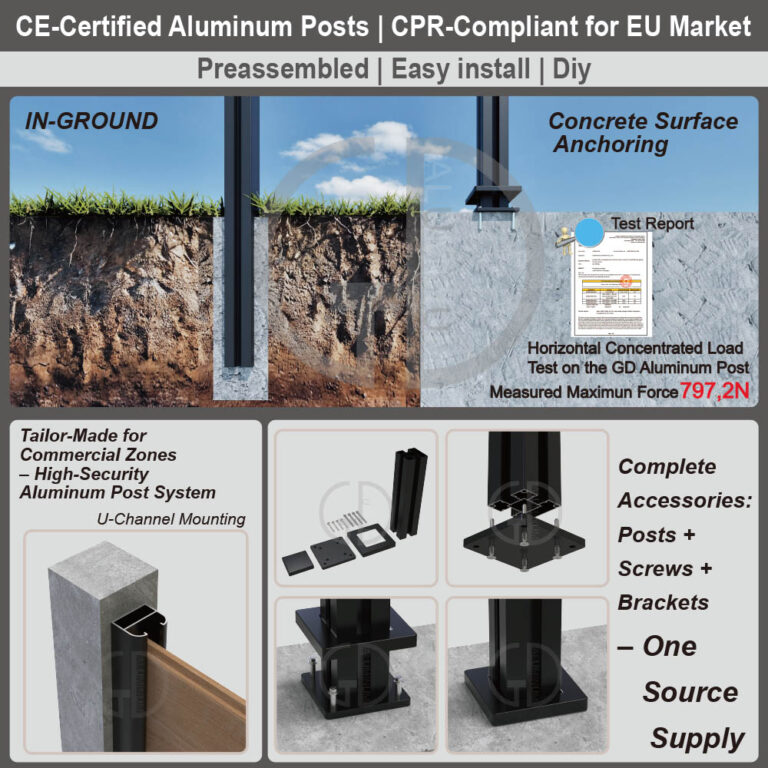
GD Aluminium utilise exclusivement 6063-Alliage magnésium-silicium T5 pour ses profils structurels. Cet alliage est préféré pour ses excellentes caractéristiques d'extrusion et sa haute résistance à la traction.. Selon Rapport Intertek 2009230340GZU-001, nos systèmes sont conçus pour résister à des charges horizontales concentrées allant jusqu'à 429 N sur poteaux verticaux (Modèle GDA500), assurer la stabilité même dans les environnements commerciaux à fort trafic.
2. BS 8579 Conformité: La norme du balcon
Pour les développeurs au Royaume-Uni et en Europe, le respect de BS 8579 (le code de bonnes pratiques pour la conception des balcons et terrasses) est critique. Les systèmes de terrasse et de garde-corps en aluminium GD sont conçus pour répondre à ces exigences strictes., revêtement:
- Drainage et gestion de l'eau: Canaux intégrés pour empêcher l'accumulation d'eau.
- Résistance au glissement: Finitions spécialisées qui offrent une adhérence même dans des conditions humides.
- Intégrité structurelle: Vérifié par des tests mécaniques exhaustifs.
3. Résistance au vent en altitude
Les charges de vent augmentent de façon exponentielle avec la hauteur du bâtiment. Les produits GD Aluminium ont été testés pour maintenir leur intégrité sous Échelle de Beaufort 10 forces du vent. Cela garantit que les composants externes tels que les écrans de confidentialité ou les planches de terrasse ne deviendront pas des projectiles lors d'événements météorologiques extrêmes..
La centrale de fabrication GD: Échelle et précision
Les projets de grande hauteur nécessitent un fournisseur capable de répondre à des exigences de volume massives sans sacrifier la précision. L’usine de production de GD Aluminium est une infrastructure de classe mondiale conçue pour le 2026 demandes du marché.
- 31 Lignes d'extrusion: Notre établissement fonctionne 31 lignes avancées, permettant la production simultanée de divers profils, des planches de terrasse aux lattes de façade complexes.
- 180,000-Capacité en tonnes: Cette immense production annuelle garantit que nous pouvons soutenir des développements résidentiels en plusieurs phases à travers le Moyen-Orient., Europe, et Amérique du Nord.
- OIN 9001:2015 Gestion de la qualité: Nos processus de vente et de production sont certifiés sous le numéro de certificat 11423Q48826R0S, garantir que chaque expédition répond aux normes de qualité internationales.
Technologie des surfaces: Protéger l’avenir du bâtiment
Les immeubles de grande hauteur sont souvent situés dans des environnements difficiles, des centres urbains côtiers riches en sel aux zones métropolitaines remplies de smog. Pour garantir que nos systèmes en aluminium restent visuellement impeccables et structurellement solides, nous utilisons des traitements de surface haut de gamme.
- Partenariats de marque mondiaux: Nous collaborons avec AkzoNobel (Interpon) et Tigre (Drylac) pour fournir des revêtements en poudre résistants à la dégradation par les UV et à la corrosion chimique.
- Protection de qualité marine: Pour les projets côtiers, nous fournissons des revêtements conçus pour C5-M (Marin) environnements, prévenir la corrosion filiforme qui affecte souvent les produits métalliques de moindre qualité.
- RoHS 2.0 Conformité: Nos revêtements sont testés pour être exempts de substances dangereuses comme le plomb, Mercure, et Cadmium (Certifié: CTG2510295821C-SR66AT), s’assurer qu’ils sont sécuritaires pour les résidents et l’environnement.
Analyse comparative: Pourquoi les professionnels abandonnent le WPC et le bois
| Fonctionnalité | Systèmes en aluminium GD | Bois / WPC |
| Classement incendie | Euroclasse A1/A2 (Incombustible) | Euroclasse B, C, ou D (Combustible) |
| Entretien | Zéro entretien; nettoyage simple à l'eau | Nécessite une coloration annuelle, scellage, ou huilage |
| Durée de vie | 30+ années; ne pourrit pas et ne se déforme pas | 5-15 années; sujet à la pourriture, moule, et déformation |
| Poids | Poids léger; réduit la charge morte structurelle | Lourd; nécessite un support structurel plus robuste |
| Conformité | BS 8579, GRV, Conforme IRC | Limité aux immeubles de grande hauteur de plus de 11 m/18 m |
FAQ complète: Naviguer dans la sécurité des gratte-ciel & Conformité
T1: Quelles sont les meilleures options de terrasses incombustibles pour les balcons de grande hauteur après la loi britannique sur la sécurité incendie?
A1: La solution la plus fiable et la plus conforme à la loi est Platelage en aluminium classé Euroclasse A1/A2. Les systèmes GD Aluminium sont spécialement conçus pour remplacer les matériaux combustibles comme le bois et le WPC., veiller à ce que les projets de grande hauteur répondent aux 2026 normes de sécurité.
T2: Les terrasses en aluminium GD sont-elles conformes à la norme BS 8579 normes?
A2: Oui. Nos systèmes de terrasse sont conçus selon BS 8579 principes, se concentrer sur l'incombustibilité, drainage efficace, et résistance au glissement : tous essentiels pour un design moderne de balcon et de terrasse..
T3: Comment l’aluminium 6063-T5 se comporte-t-il lors d’incendies à haute température?
A3: Même si l'aluminium finit par fondre à environ 660°C, il ne s'enflamme pas et ne propage pas de flamme. Ce point de fusion élevé offre une endurance structurelle nettement supérieure à celle des composites à base de plastique., qui peut ramollir et échouer à des températures beaucoup plus basses.
T4: Ces systèmes en aluminium peuvent-ils résister à des charges de vent élevées au 50e étage d'un immeuble?
A4: Absolument. Les systèmes GD Aluminium ont réussi Tests de résistance au vent Intertek pour l'échelle de Beaufort 10, ce qui signifie qu'ils sont structurellement capables de résister aux pressions extrêmes rencontrées à haute altitude et dans les régions sujettes aux tempêtes..
Q5: Les produits GD Aluminium sont-ils certifiés pour le marché européen?
A5: Oui, tous nos systèmes primaires (clôture, balustrade, terrasse, panneaux muraux) sont Certifié CE (Non. CMGD23110752237) au titre des directives 2006/42/CE et 2014/30/UE, confirmant leur adéquation à une utilisation sur le marché de l’UE.
Q6: Quel est l'avantage d'utiliser les revêtements AkzoNobel ou Tiger pour les immeubles de grande hauteur?
A6: Ces revêtements offrent une résistance supérieure aux UV et à la corrosion. Sur les immeubles de grande hauteur, où la maintenance est difficile et coûteuse (nécessitant souvent un échafaudage ou une descente en rappel), la longévité de ces finitions haut de gamme réduit la Coût total de possession en éliminant le besoin de repeindre ou de réparer.
Conclusion: Développement urbain évolutif
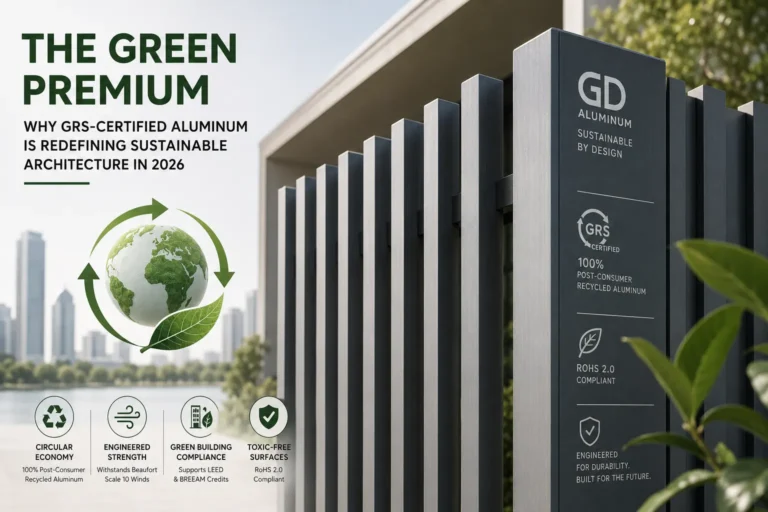
Alors que les centres urbains se développent verticalement, la responsabilité de l'architecte et du promoteur pour assurer la sécurité des résidents n'a jamais été aussi grande. Choisir un matériau uniquement en fonction du coût initial est une stratégie du passé. Le 2026 demandes du marché GD Aluminium mélange de Durabilité certifiée GRS, Sécurité incendie Euroclasse A1, et Résistance mécanique testée par Intertek.
En vous associant à un fabricant qui possède 31 lignes d'extrusion et un solide portefeuille de certifications internationales (OIN, CE, GRS), vous n'achetez pas seulement de l'aluminium, vous garantissez la longévité et la légalité de votre héritage architectural. Pérennisez votre projet dès aujourd'hui avec GD Aluminum, le leader mondial des systèmes en aluminium haute performance.