Nowoczesna automatyka bram wjazdowych: 7 Istotne kontrole inżynieryjne dla specyfikatorów
Nowoczesna automatyka bram wjazdowych: 7 Istotne kontrole inżynieryjne dla specyfikatorów
An automated perimeter gate is only as reliable as the mechanical structure carrying the motor. Gdy zawiedzie automatyczne wejście, the fault rarely lies in the microprocessor board; it almost always originates from structural deflection, improper motor bracket anchoring, hinge binding under wind shear, or motor gear stripping caused by excessive gate inertia. Określanie modern driveway gate automation requires evaluating both the aluminum structural fabrication and the electromechanical drive system as a unified engineering assembly.
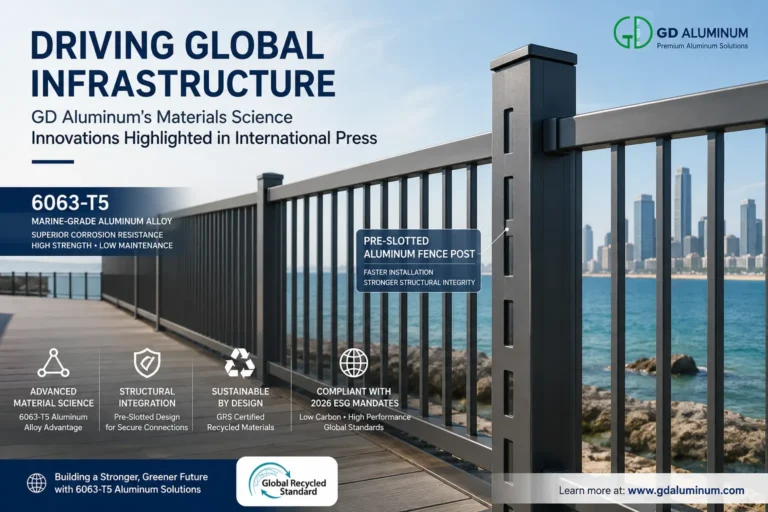
W GD Aluminium (佛山市斯特图铝业有限公司), our engineering team designs and manufactures architectural-grade driveway gates extruded from high-tensile 6063-Stop aluminium T6. Because aluminum offers one-third the density of structural steel with exceptional torsional stiffness when engineered with internal reinforcement webs, it drastically reduces motor load cycles and gearbox thermal degradation. In this technical guide, we review the seven essential engineering and compliance criteria that architects, civil contractors, and commercial specifiers must assess when engineering an automated driveway entrance.
Why Does Gate Material Physics Determine Modern Driveway Gate Automation Longevity?
In automated swing and sliding gate systems, motor actuators apply concentrated point loads at the drive bracket mounting zone. Heavy wrought iron or mild steel gates place continuous static deadweight on hinges and roller bearings, leading to post deflection and mechanical binding. Nadgodziny, hinge pin misalignment increases frictional resistance, forcing automation motors to draw excessive amperage and triggering nuisance obstruction stall errors.
Engineered 6063-T6 aluminum eliminates these failure modes through high strength-to-weight efficiency. With a yield strength exceeding 170 MPa and an elastic modulus tailored for dynamic wind absorption, our aluminum gate leaves reduce kinetic momentum during rapid deceleration. This preserves drive arm ball joints, internal worm screws, and planetary gearboxes across hundreds of thousands of duty cycles.

How to Select the Right Drive Mechanism for Modern Driveway Gate Automation
Selecting the appropriate automation motor geometry depends on leaf width, open/close frequency, local wind exposure, and site gradient. Specifiers must choose between four primary drive topologies, each presenting distinct mechanical characteristics:
| Automation Topology | Mechanical Drive Mechanism | Ideal Gate Geometry & Aplikacja | Key Engineering Advantages | Critical Design Considerations |
|---|---|---|---|---|
| Linear Ram Actuator | Worm screw or hydraulic piston extending along gate leaf | Dual or single swing gates up to 5.0m per leaf; mieszkaniowy & light commercial | High mechanical push/pull leverage; self-locking gearbox; simple post mounting | Requires substantial rear post clearance and reinforced mid-rail bracket anchoring |
| Articulated Arm Operator | Rotary motor driving a folding articulated linkage arm | Swing gates mounted on wide brick/concrete masonry pillars | Overcomes large hinge-to-post offset distances; smooth deceleration curve | Exposed mechanical scissor arm requires safety pinch-point zone guarding |
| Underground In-Ground Motor | Concealed IP67/IP68 foundation box housing motor & shoe hinge | High-end architectural entrances and historical estate perimeters | 100% invisible automation footprint; up to 180° swing angle capability | Demands precision subsurface gravel drainage and routine debris maintenance |
| Rack-and-Pinion Sliding Drive | Rotary drive pinion engaging reinforced nylon/steel rack | Single or bi-parting sliding gates; steep slopes; high-wind coastal zones | Zero leaf swing arc; extreme wind shear resistance; high-duty commercial cycling | Requires straight track run-out clearance equal to total driveway opening width |
For extensive design recommendations on tailoring swing and sliding layouts to complex site elevations, examine our comprehensive guide on custom aluminum gate design.
How Does Wind Load Affect Modern Driveway Gate Automation Reliability?
Wind loading represents the single most destructive dynamic force acting upon an automated driveway gate. When a solid privacy gate leaf is caught mid-cycle by a sudden gust, the surface acts as an aerodynamic sail, generating massive torque against the actuator drive arm and post mounting plates.
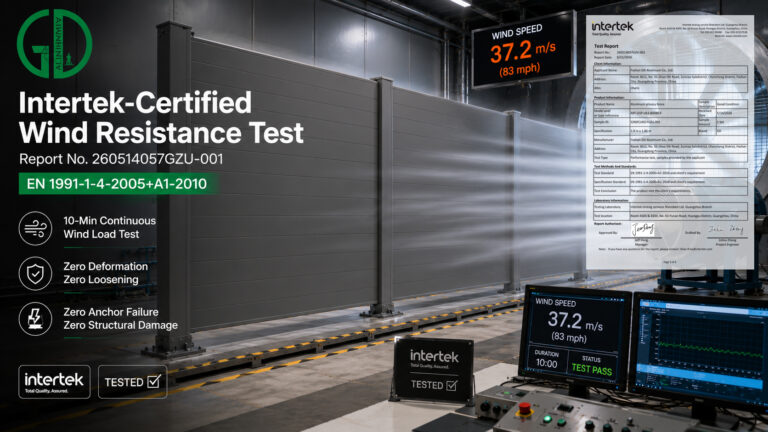
Standard off-the-shelf residential motors feature sensitive obstacle detection algorithms designed to reverse upon contacting an obstacle. High wind resistance mimics physical obstructions, causing automated gates to falsely reverse or stall halfway across the driveway. GD Aluminum gate profiles are verified by independent Intertek laboratory testing up to 510 N/m² (certified for Typhoon Level 10 wind resistance), engineered with internal structural stiffeners that prevent torsional leaf twisting under severe lateral pressure. For exposed coastal properties, specifiers should combine louvered or aerodynamically slotted infill slats with hydraulic locking dampeners to safeguard drive arm gear assemblies.
What Safety Compliance Standards Govern Modern Driveway Gate Automation?
Automated vehicular gates are classified as motorized machinery under international building codes. Failure to specify certified safety mechanisms exposes property owners, facilities managers, and engineering contractors to severe legal liability in the event of entrapment or collision. Every modern driveway gate automation installation must comply with two internationally recognized standards frameworks:
- UL 325 & ASTM F2200 (North America): Mandates a minimum of two monitored external entrapment prevention devices (such as fail-safe thru-beam photo eyes and monitored wireless safety edge strips), continuous visual warning strobes, and maximum clearance limits under gate leaves to prevent limb entrapment.
- W 12453 & W 12604 (Europa & Wielka Brytania): Governs mechanical design and dynamic impact force thresholds. Dictates that peak closing impact force must not exceed 400 N, dissipating below 150 N within 0.75 seconds upon obstacle contact. Requires annual force testing documentation.
- Manual Emergency Release Access: Every automated gate operator must incorporate an ergonomic, keyed mechanical disconnect clutch to allow manual operation during municipal power grid failures or emergency vehicle access.
How Does Surface Treatment Prevent Electrical and Mechanical Seizure?
Driveway gate automation involves critical interfaces between moving mechanical components: stainless steel hinge pins, bronze bushings, magnetic limit switch brackets, motor foundation plates, and electrical junction boxes. In coastal or industrial environments, moisture and airborne chlorides trigger galvanic corrosion and oxidation that seize mechanical pivots and short-circuit sensitive photocell wiring.
GD Aluminum applies architectural-grade AMAMA 2604 and AAMA 2605 polyester powder coatings (80–100 μm dry film thickness) subjected to rigorous ISO 9227 2,000-hour neutral salt spray testing. This provides an impenetrable barrier against electrochemical degradation, ensuring mounting brackets, limit brackets, and concealed wiring raceways remain 100% corrosion-free for over 25 lata. Review the technical differences between finishing methods in our analysis of powder coating vs painting for gates.
B2B Specifier Audit Checklist: Procuring Modern Driveway Gate Automation
Before issuing requests for quotation (RFQ) or approving shop drawings for commercial residential developments, utilize our engineering procurement checklist to ensure zero scope gaps:
| Verification Item | Engineering Requirement | Compliance Benchmark | Audit Verification Method |
|---|---|---|---|
| Extrusion Alloy & Hartować | 6063-T6 architectural aluminum | Yield strength ≥ 170 MPa; Ultimate ≥ 205 MPa | Świadectwo testu młyna (MTC) & Spectrometric Analysis |
| Wind Load Resistance | Dynamic wind pressure tolerance | 510 N/m² (Typhoon Level 10 Atestowany) | Intertek Static/Dynamic Pressure Test Report |
| Surface Finish & Gwarancja | Architectural electrostatic powder coating | AMAMA 2604 / AMAMA 2605; ISO 9227 (2,000h) | Coating Thickness Gauge & 10-Year Written Warranty |
| Safety Entrapment System | Monitored primary & secondary safety devices | UL 325 Class I-IV / W 12453 Zgodność | CE / UKCA Declaration of Conformity & Impact Graphs |
| Drive Duty Cycle | Motor continuous run rating | ≥ 80% (Mieszkaniowy) / 100% Continuous (Handlowy) | Manufacturer Thermal Overload Curve Spec Sheet |
| Emergency Power Backup | Integrated DC battery buffer / Solar ready | Minimum 30-50 full open/close cycles on reserve | 24V DC Float Charger & Battery Discharge Test |
For detailed supplier inspection protocols and factory auditing criteria, refer to our comprehensive guide on supplier auditing for aluminum manufacturers.
Frequently Asked Questions About Modern Driveway Gate Automation
Pytanie 1: Why is 6063-T6 aluminum superior to steel for automated driveway gates?
Aluminum weighs approximately 65% less than structural steel while providing exceptional tensile strength and structural rigidity. Lower deadweight reduces physical wear on motor gears, motor bearings, and hinge pins, lowering operating energy consumption and extending automation motor lifespan by over 50% without rust risk.
Pytanie 2: What happens to automated driveway gates during a power outage?
Professional modern driveway gate automation systems feature two standard fail-safe mechanisms: an onboard 24V DC rechargeable backup battery capable of performing 30 Do 50 operational cycles, and a manual emergency release key that uncouples the drive gearbox for effortless manual push-open operation.
Pytanie 3: How do automated gates withstand high winds without burning out motors?
GD Aluminum gates utilize high-section-modulus structural posts and internal web stiffeners rated to Intertek 510 N/m² wind load. When paired with commercial-grade 24V DC brushless or hydraulic motors featuring variable torque management and louvered infill designs, gates operate smoothly through heavy gusts without triggering false obstacle reversals.
Pytanie 4: Can modern driveway gate automation integrate with commercial access control systems?
Tak. Advanced gate control panels support dry contact relays, Wiegand interfaces, and RS-485 serial communication, allowing direct integration with license plate recognition (LPR) cameras, RFID transponders, cellular 4G/IP video intercoms, keypad consoles, and smart home management platforms.
Partner with GD Aluminum for Custom Engineered Automated Gate Solutions
GD Aluminium (佛山市斯特图铝业有限公司) provides end-to-end B2B manufacturing, structural calculation, and custom OEM/ODM fabrication for architectural contractors, gate installers, and property developers worldwide. From heavy-duty cantilever sliding gates to bespoke automated double swing systems, our factory delivers verified 6063-T6 extrusions with precision CNC machining, AMAMA 2604 coating, and full international compliance certification.
Request Technical Support & Factory Direct Quotations:
Direct WhatsApp Consultation: +86 139 2953 0982
Official Website: https://gdaluminium.com/
E-mail: [email protected]