Kostnadsanalys av stängselprojekt: 7 Beprövade livscykelkostnadsbenchmarks
Kostnadsanalys av stängselprojekt: 7 Beprövade livscykelkostnadsbenchmarks
When evaluating commercial, bostadsutveckling, eller industriella perimeteranbud, procurement teams frequently make the mistake of comparing bids solely on initial material price per linear meter. Dock, a rigorous cost analysis of fencing projects demonstrates that initial capital expenditure (CapEx) represents only 30% till 45% of total perimeter expenditure over a standard 25-year asset lifecycle. Hidden costs—including on-site installation labor, heavy freight logistics, periodic surface recoating, rust remediation, and storm damage repairs—dictate the true financial outcome of the project.
Hos GD Aluminium (佛山市斯特图铝业有限公司), we engineer high-grade architectural fencing systems extruded from 6063-T6 aluminiumlegering. By optimizing extrusion wall profiles, integrating patented fast-install post hardware, and applying architectural AAMA 2604 pulverbeläggningar, our factory delivers perimeter solutions that minimize Total Cost of Ownership (TCO). In this technical guide, we break down the seven essential cost drivers that developers, civil contractors, and facility managers must evaluate to optimize project ROI.
How Does Initial CapEx Differ from 25-Year Total Cost of Ownership (TCO)?
A comprehensive perimeter financial model separates initial deployment expenditure from compounding operational costs (OpEx). While timber or ungalvanized steel fencing often displays the lowest initial material price, their steep maintenance trajectories make them significantly more expensive over time.
The table below models the 25-year lifecycle cost performance across four common commercial perimeter materials per 100 linear meters (1.8m height baseline):
| Perimeter Material System | Initial Material & Hardware Cost | Installation Labor & Equipment | 25-Year Maintenance & Repainting | Storm & Corrosion Replacement Risk | Estimated 25-Year TCO per 100m |
|---|---|---|---|---|---|
| 6063-T6 Aluminum (GD aluminium) | Moderate-High | Låg (Modular fast-assembly) | Near Zero (Periodic water rinse) | Låg (ISO 9227 & Intertek 510 N/m²) | Lowest Overall TCO |
| Galvanized Steel / Wrought Iron | Måttlig | Hög (Heavy crane & svetsning) | Hög (Rust scraping & repainting every 5-7 yrs) | Måttlig (Cut-edge corrosion) | Hög (+45% vs Aluminum) |
| Wood-Plastic Composite (WPC) | Moderate-High | Måttlig (Heavy solid boards) | Low-Moderate (UV-blekning & mold washing) | Hög (Thermal warping & brittle failure) | Måttlig (+30% vs Aluminum) |
| Pressure-Treated Timber | Låg (Lowest initial bid) | Måttlig (Manual carpentry) | Extremely High (Staining, tätning, rotting) | Severe (Termite, ruttna, wind snapping) | Highest (+85% vs Aluminum) |
To analyze security perimeter specifications in detail, review our financial framework on commercial security fencing ROI.
How Does On-Site Installation Labor Impact the Cost Analysis of Fencing Projects?
Field labor represents one of the largest and most volatile cost components on civil construction sites. Traditional steel fencing requires certified welders, heavy crane lifting equipment, and field touch-up painting to cover scorched joints. Wood fencing requires piece-by-piece carpentry that extends site schedules.
In contrast, modular 6063-T6 aluminum fence systems utilize precision factory-extruded components:
- Lightweight Handling: Aluminum panels weigh approximately 65% less than steel, allowing a two-person crew to transport and set panels without mechanical lifting machinery.
- Patented Swivel Post Technology (ZL202030484671.6): GD Aluminum’s patented adjustable swivel post system accommodates 0° to 90° angle transitions and undulating terrain contours without custom field fabrication, reducing on-site labor hours by 30% till 40%.
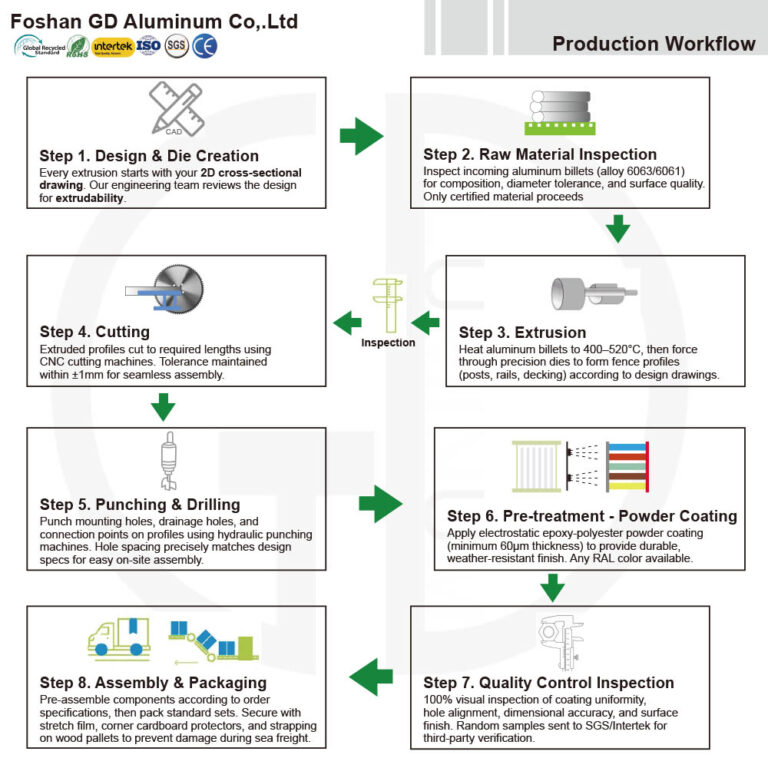
- Pre-Drilled & Snap-Lock Assembly: Factory CNC precision eliminates on-site drilling, skärande, and welding, reducing contractor installation risk and speeding up commercial project handovers.
Why Do Shipping Freight and Logistics Dramatically Influence Perimeter Budgeting?
For international developments and large-scale regional tenders, transportation logistics can represent up to 15% till 20% of total procurement costs. Because sea freight and overland trucking are constrained by container payload weight limits (typiskt 21 till 26 metric tons per 40ft HQ container), heavy steel or dense WPC composite materials reach container weight limits long before utilizing available volumetric space.
Aluminum’s low density (2.70 g/cm³) enables high-density knockdown flat-pack containerization. Contractors can ship up to 2.5 times more linear meters of aluminum fencing per container compared to steel, drastically cutting per-meter freight costs and carbon emissions during transit. Explore bulk procurement strategies in our guide to wholesale aluminum fence panels.
How Does Certified Wind Load Engineering Prevent Catastrophic Replacement Costs?
Perimeter failure during storm and typhoon events creates immense financial liability, including emergency repairs, perimeter security breaches, and property damage insurance claims. Solid privacy fences act as massive wind sails, placing immense bending stress on fence posts and foundation footings.
GD Aluminum fence systems undergo rigorous independent laboratory testing, achieving Intertek certified wind pressure resistance up to 510 N/m² (tested for Typhoon Level 10 villkor). By engineering high section modulus post geometry and internal structural stiffeners, our aluminum systems withstand extreme wind shear without permanent plastic deformation, preventing costly post-storm panel replacements.

What Is the Long-Term Cost Value of Architectural Powder Coating?
Repainting a commercial fence in the field is exponentially more expensive than factory electrostatic coating. Field painting involves scaffolding access, chemical rust stripping, overspray masking, and unpredictable weather delays.
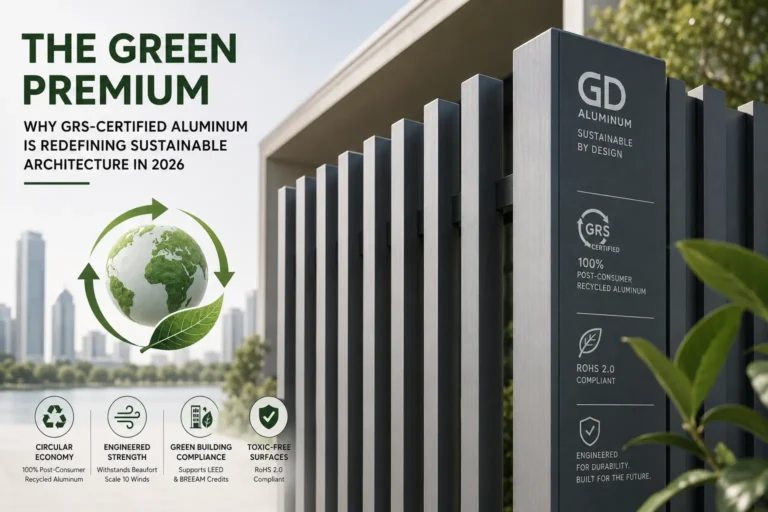
GD Aluminum applies architectural-grade AMAMA 2604 och AAMA 2605 polyester powder coatings (80–100 μm dry film thickness), verified by ISO 9227 2,000-hour neutral salt spray laboratory testing. Backed by a 10-year factory finish warranty, our coating resists chalking, color fading, and salt spray degradation across 25+ years without repainting. Dessutom, aluminum is 100% återvinningsbart, retaining substantial scrap metal equity at the end of the building lifecycle and complying with European CBAM (Justeringsmekanism för kolgräns) sustainability directives.
Contractor Procurement Audit Checklist: Fencing Project Cost Optimization
Use this procurement checklist to audit competing perimeter bids and eliminate hidden financial risks:
| Audit Category | Target Specification | Cost Optimization Benefit | Required Documentation |
|---|---|---|---|
| Raw Alloy Specification | 6063-T6 Architectural Aluminum | High tensile strength prevents post bowing and warping | Bruksprovningscertifikat (MTC) |
| Wind Load Verification | 510 N/m² (Tyfonnivå 10 Auktoriserad) | Eliminates post-storm structural failure & liability | Intertek Static/Dynamic Pressure Test Report |
| Ytfinish & Långt liv | AMAMA 2604 / AMAMA 2605 (ISO 9227 2,000h) | Zero recurring repainting or rust remediation costs | 10-Year Written Coating Warranty |
| Modular Assembly Hardware | Patented 0°–90° Swivel Post System | Cuts on-site field installation labor by 30%+ | Patent Certificate ZL202030484671.6 & CAD Guide |
| Freight & Förpackning | Knockdown flat-pack export crating | Maximizes container volume; cuts shipping freight by ~50% | Container Packing Optimization Calculation |
| Carbon & Miljö | 100% Recyclable Green Aluminum | Avoids carbon border tariffs & retains residual equity | CBAM Compliance & Factory Green Audit |
For factory audit methodologies and inspection protocols, read our guide on supplier auditing for aluminum manufacturers.
Frequently Asked Questions About Cost Analysis of Fencing Projects
Q1: Why is aluminum fencing more cost-effective than steel over a 25-year period?
Although initial material prices can be similar, steel fencing requires periodic rust scraping, primer application, and repainting every 5 till 7 år. In contrast, 6063-T6 aluminum with AAMA 2604 coating requires zero repainting and zero rust remediation, resulting in a 40% till 50% lower 25-year Total Cost of Ownership.
Q2: How does modular aluminum fencing reduce on-site labor expenses?
Aluminum weighs 65% less than steel, eliminating the need for heavy lifting machinery. Combined with GD Aluminum’s patented swivel post fittings and pre-engineered snap-lock channels, installation crews complete perimeter runs 30% till 40% faster than traditional welded fencing.
Q3: How do shipping logistics affect the per-meter cost of fencing?
Because container shipping is constrained by weight limits, heavy steel reaches max payload with empty space remaining. Aluminum’s lightweight profile allows up to 2.5 times more linear meters of flat-packed fencing per container, substantially lowering international freight costs per meter.
Q4: What is the residual scrap value of aluminum fencing at the end of its lifecycle?
Aluminum is infinitely recyclable without losing its physical properties. At the end of a 25-to-30-year building lifecycle, aluminum perimeters can be recycled and sold as clean scrap metal, recovering up to 20% till 30% of their raw material value, unlike rusted steel or degraded composite.
Partner with GD Aluminum for Optimized Commercial Perimeter Solutions
GD aluminium (佛山市斯特图铝业有限公司) provides direct factory manufacturing, CAD value engineering, and custom OEM/ODM extrusion for fencing contractors, civil developers, and distributors worldwide. Our technical team delivers cost-optimized, certified perimeter systems with guaranteed lead times and complete international compliance documentation.
Contact GD Aluminum for Custom Takeoffs & Factory Direct Pricing:
Direct WhatsApp Consultation: +86 139 2953 0982
Official Website: https://gdaluminium.com/
E-post: [email protected]