Acoustic Fencing for Urban Areas: 6 Critical Sound Attenuation Standards
Acoustic Fencing for Urban Areas: 6 Critical Sound Attenuation Standards
Urban density, expanding arterial highway networks, and continuous commercial activity have elevated environmental noise pollution into a major public health and property valuation issue. Conventional timber or decorative steel fences offer minimal acoustic performance because sound waves easily penetrate gaps, porous joints, and lightweight boards. Specifying engineered acoustic fencing for urban areas requires understanding sound transmission physics, mass law attenuation, and structural wind resistance to create effective acoustic shadow zones.
Bei GD Aluminium (佛山市斯特图铝业有限公司), our engineering team designs and manufactures high-performance acoustic barrier assemblies utilizing structural 6063-T6 aluminum cassette profiles. Engineered with dense acoustic internal damping cores, micro-perforated sound absorption faces, and airtight tongue-and-groove acoustic interlocking joints, our systems provide certified decibel reduction across commercial, municipal, and residential boundaries. In this technical guide, we examine the six essential acoustic and structural benchmarks required to specify urban noise barriers.
How Does Acoustic Physics Govern Sound Attenuation in Urban Boundaries?
Effective acoustic barrier design relies on two primary physical mechanisms: Sound Transmission Loss (STL) Und Diffraction Geometry. To prevent sound energy from passing directly through the perimeter wall, the barrier must provide sufficient surface mass (Mass Law) and be 100% airtight, as even a 1% open gap can reduce overall sound attenuation by up to 10 dB.
When sound waves strike an acoustic fence, energy is reflected away, absorbed within internal acoustic dampening media, or diffracted over the top edge. The acoustic barrier creates a “sound shadow” behind the wall where noise levels drop significantly. For maximum attenuation, the barrier must be tall enough to break the direct line of sight between the noise source (z.B., vehicle tires or HVAC compressors) and the receiving ear height.

Engineering Benchmark: Urban Noise Sources vs Acoustic Attenuation Targets
Specifying the appropriate acoustic barrier configuration requires matching urban frequency spectra with target decibel reductions:
| Urban Noise Source Type | Dominant Frequency Spectrum | Typical Unmitigated SPL | Target Attenuation (STC Rating) | Recommended Barrier Construction |
|---|---|---|---|---|
| Arterial Highway Traffic | Low-Mid (250 Hz – 1,000 Hz) | 75 dB(A) Zu 85 dB(A) | STC ≥ 32 dB (10–15 dB reduction) | Dual-skin aluminum cassette with dense hydrophobic mineral wool core |
| Commercial Rooftop HVAC & Chillers | Low Frequency Rumble (63 Hz – 250 Hz) | 80 dB(A) Zu 90 dB(A) | STC ≥ 36 dB (15–20 dB reduction) | Perforated front absorption face with viscoelastic mass-loaded barrier |
| Light Rail & Train Corridors | Wide Spectrum / High Vibration | 85 dB(A) Zu 95 dB(A) | STC ≥ 35 dB (12–18 dB reduction) | Reinforced H-post structural aluminum sound wall with acoustic seals |
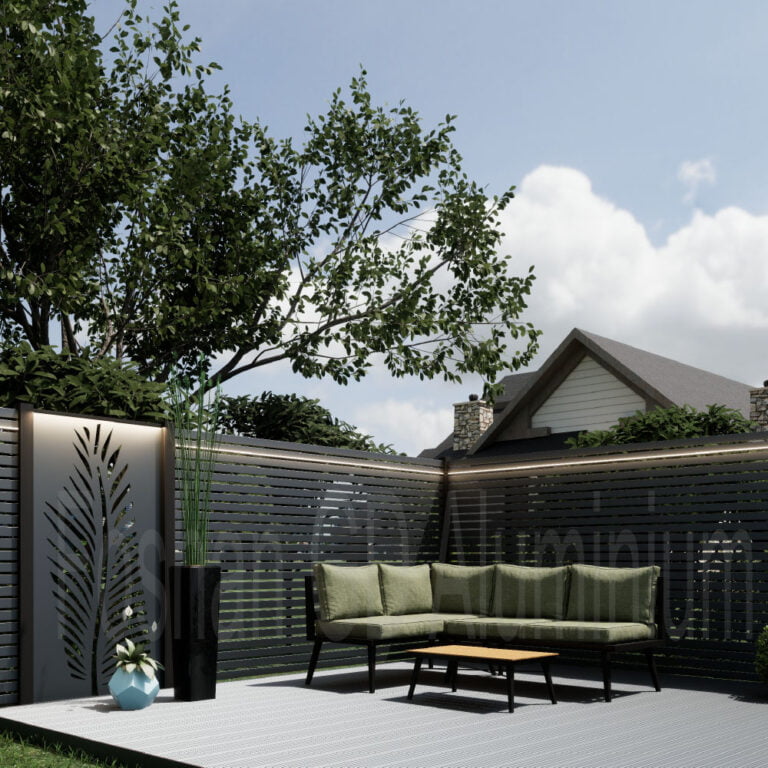
| Urban Residential / Commercial Perimeter | Mid-High (500 Hz – 4,000 Hz) | 65 dB(A) Zu 75 dB(A) | STC ≥ 28 dB (8–12 dB reduction) | Architectural aluminum acoustic slat panel with tongue-and-groove seals |
To evaluate commercial boundary economics, explore our analysis on commercial security fencing ROI.
Why Is Aluminum Superior to Concrete and Timber for Urban Acoustic Barriers?
Historisch, heavy precast concrete walls or timber boards were deployed for noise control. Jedoch, concrete imposes massive structural deadweights requiring expensive deep pilings, while timber rots, shrinks, and develops acoustic leaks within a few years of outdoor exposure.
Modular 6063-T6 aluminum acoustic panels offer significant structural and acoustic advantages:
- Lightweight Structural Efficiency: Aluminum acoustic panels weigh only 15 Zu 25 kg/m² compared to 200+ kg/m² for concrete, enabling installation on bridges, retaining walls, parking structures, and rooftop plant decks without structural reinforcement.
- Airtight Interlocking Tongue-and-Groove Seals: Precision extruded aluminum profiles incorporate continuous EPDM acoustic compression gaskets, completely preventing sound leakage between panel courses.
- Integrated Sound Absorption Faces: Aluminum panels can be CNC micro-perforated on the noise-facing side, trapping sound waves inside the internal mineral core (achieving NRC ratings ≥ 0.85) to eliminate echo reflections in narrow urban street canyons.
How Does Wind Load Engineering Protect Tall Urban Acoustic Fencing?
Because acoustic barriers must be solid and tall (typically 2.0m to 3.5m height) to break sound wave line-of-sight, they experience massive lateral wind overturning forces during storm events. Thin-gauge posts or improperly anchored footings will buckle under high wind suction.
GD Aluminum acoustic barrier systems are verified by independent Intertek laboratory testing up to 510 N/m² (certified for Typhoon Level 10 wind resistance). Utilizing heavy-wall extruded aluminum H-posts (100 × 100mm to 150 × 150mm) with internal structural web stiffeners, our systems absorb extreme aerodynamic wind pressure, ensuring long-term structural safety in exposed urban corridors. Discover our low-maintenance engineering in our guide to wartungsfreie Zaunlösungen.

What Surface Protection Prevents Urban Corrosion and De-Icing Salt Damage?
Urban roadside perimeters are subjected to intense atmospheric chemical attacks: vehicle exhaust emissions, sulfur dioxides, airborne road grime, and aggressive winter de-icing salts. Inferior steel fences quickly develop cut-edge rust and bubbling paint within 24 Zu 36 months.
GD Aluminum applies architectural-grade AMAMA 2604 and AAMA 2605 electrostatic polyester powder coatings (80–100 μm dry film thickness), proven by ISO 9227 2,000-hour neutral salt spray testing. Backed by a 10-year written warranty, our finishes resist chemical corrosion and UV chalking across 25+ years without repainting. Außerdem, unser 100% recyclable green aluminum complies with European CBAM (Mechanismus zur Anpassung der CO2-Grenze) Standards.
Specifier Audit Checklist: Procuring Acoustic Fencing for Urban Areas
Use this engineering procurement checklist to audit acoustic barrier submittals before project sign-off:
| Engineering Item | Technical Target Benchmark | Verification Method | Specifier Impact |
|---|---|---|---|
| Acoustic Transmission Loss | STC ≥ 30–36 dB / NRC ≥ 0.85 | ASTM E90 / ISO 10140 Lab Test Report | Guarantees certified decibel reduction across target frequencies |
| Panel Structural Alloy | 6063-T6 Architectural Aluminum | Mühlentestzertifikat (MTC) | Provides high strength-to-weight ratio and corrosion immunity |
| Wind Pressure Rating | 510 N/m² (Taifun-Level 10 Zertifiziert) | Intertek Dynamic Wind Load Report | Prevents structural failure and post bending in storm events |
| Acoustic Core Material | Hydrophobic high-density mineral wool (≥ 80 kg/m³) | Material Safety Data Sheet (MSDS) & Brandschutzklasse | Nicht brennbar (Class A) with zero water absorption |
| Surface Durability | AMAMA 2604 / AMAMA 2605 (ISO 9227 2,000h) | Salt Spray Laboratory Test Certificate | Eliminates road salt corrosion and repainting maintenance |
| Modular Post Connections | Heavy-duty extruded H-posts with EPDM gaskets | Shop Drawings & Engineering Calculations | Ensures 100% airtight acoustic seals without sound leakage |
For factory quality audit methodologies, read our article on supplier auditing for aluminum manufacturers.
Frequently Asked Questions About Acoustic Fencing for Urban Areas
Q1: How much noise reduction can acoustic fencing achieve in urban areas?
A properly engineered aluminum acoustic barrier typically achieves a 10 dB(A) Zu 15 dB(A) reduction in perceived noise levels. Because decibels operate on a logarithmic scale, A 10 dB reduction represents a 50% decrease in perceived loudness to the human ear.
Q2: What is the minimum recommended height for an urban acoustic fence?
To be acoustically effective, the barrier must completely break the direct line of sight between the noise source and the listener. In urban residential boundaries, heights typically range from 2.0 meters to 2.4 Meter; adjacent to busy multi-lane highways or commercial loading docks, heights of 2.8 meters to 3.5 meters are recommended.
Q3: Does rain or humidity degrade the acoustic internal insulation?
NEIN. GD Aluminum utilizes hydrophobic, resin-bonded mineral wool cores treated with water-repellent silane compounds, enclosed in sealed aluminum cassettes with bottom weeping drainage channels that prevent water retention.
Q4: Can acoustic aluminum fencing be mounted on retaining walls and bridges?
Ja. Because extruded aluminum acoustic panels weigh up to 85% less than precast concrete sound barriers, they are routinely bolted directly onto concrete retaining walls, parking garage parapets, and bridges using engineered base plate assemblies.
Partner with GD Aluminum for Custom Engineered Acoustic Barriers
GD Aluminium (佛山市斯特图铝业有限公司) provides end-to-end B2B manufacturing, structural acoustic calculation, and custom OEM/ODM extrusion for acoustic contractors, civil infrastructure developers, and commercial builders worldwide.
Contact GD Aluminum Engineering Support for Project Inquiries & Quotations:
Direct WhatsApp Consultation: +86 139 2953 0982
Official Website: https://gdaluminium.com/
Email: [email protected]