Postes de cerca de alumínio: 5 Especificações críticas que os compradores atacadistas precisam
O caminhão chega. A tripulação descarrega. E dentro de dez minutos, alguém segura uma postagem e faz a pergunta que todo supervisor do site teme: “Esses são os certos?” If you have ever sourced postes de cerca de alumínio for a commercial project, you know that three numbers on a purchase order—height, width, color—are not enough. A post that ticks the dimensional boxes but uses the wrong alloy, an inadequate wall thickness, or a coating that delaminates in year three turns a 30-day job into a warranty claim that nobody wants to answer. This guide walks through the five specifications that determine whether a batch of postes de cerca de alumínio holds up—or folds up.
1. Alloy Grade: Why 6063-T6 Is the Floor, Not the Ceiling
Walk through any aluminum extrusion catalog and you will see 6063-T5 listed as the default. It extrudes easily. It costs less. It meets the minimum tensile requirement for light architectural trim. But fence posts are not trim. A post anchoring a six-foot panel carries wind load, impact stress from gate hardware, and decades of thermal expansion cycles. That is where the grade selection makes the difference between a structure and a liability.
6063-T6 is the same base alloy as 6063-T5, but with a full solution heat treatment and artificial aging that raises tensile strength from approximately 150 MPa to 215 MPa—a 43% increase in load-bearing capacity. The T6 temper also pushes the material’s melting point to 660°C, classifying it as A-grade non-combustible under ASTM E136 and EN 13501-1. For projects in jurisdictions enforcing post-Grenfell fire safety codes on external building elements, this is not a specification upgrade; it is a legal requirement.
In our production facility, 6063-T6 is the baseline for all structural posts. Every production batch ships with a mill test certificate documenting chemical composition and mechanical properties. If a supplier cannot produce that certificate, assume the alloy is 6060 with recycled content—and budget for replacement within a decade.
2. What Wall Thickness Is Required for Commercial Aluminum Fence Posts?
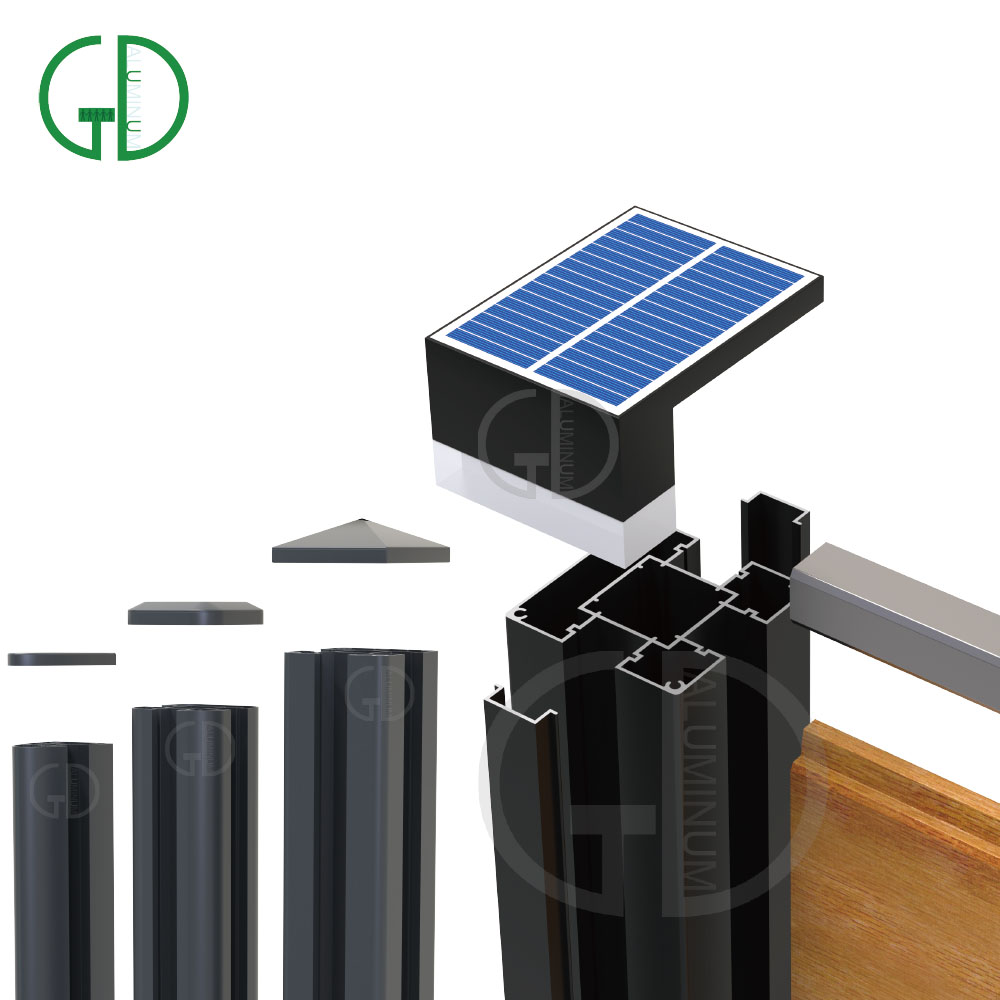
The outside dimensions of postes de cerca de alumínio—50×50 mm, 65×65 mm, 100×100 mm—tell you whether the post fits your panel system. The wall thickness tells you whether it survives the first storm season. A 65×65 mm post with a 1.2 mm wall and a 65×65 mm post with a 1.8 mm wall look identical from ten feet away. The difference is a 50% increase in cross-sectional load-bearing area. For a 1.8-meter-tall fence exposed to coastal winds, that gap determines whether the post bends at the base plate or stands through a typhoon.
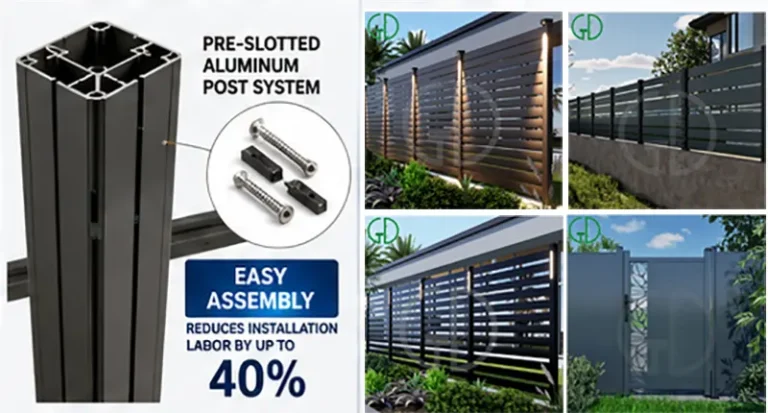
Our standard structural posts use a minimum wall thickness of 1.6 milímetros, with heavy-duty commercial options at 2.0 milímetros for high-wind zones and industrial perimeters. Beyond the thickness number, contractors should verify internal rib design. Multi-chamber extrusions with internal webbing add torsional rigidity without increasing material weight—a detail visible only on a cross-section drawing. Request one before signing the order. It takes the supplier five minutes to pull from their CAD library and tells you more about structural intent than any spec sheet.
3. Wind Load: How Post Design Determines System Certification
Post spacing, embedment depth, and base connection design determine whether a fence system earns a wind load certification—or whether the spec sheet stays blank. The post is the anchor point. It carries the full lateral load from the panel. If it fails, there is no redundant structural path.
Independent testing by Intertek on our full post-and-panel assemblies—not isolated component tests—achieved a certified rating of 510 N/m², o equivalente ao nível de tufão sustentado 10 ventos, com zero desprendimento de componentes e zero deformação estrutural. A Typhoon Level 12 certification is currently in final documentation. The practical difference between 510 N/m² and an uncertified system is not measured in wind speeds. It is measured in whether a project developer’s insurance underwriter signs off on the installed product without additional engineering review.
When comparing quotes for postes de cerca de alumínio, ask for the test report that names the specific post profile, wall thickness, and base plate configuration tested. A generic engineering calculation delivered as a PDF is not a substitute for a laboratory wind load test conducted by an accredited body.
4. Revestimento: Microns, Pretreatment, and the Salt Spray Number
“Weather-resistant powder coating” appears on a hundred supplier websites. It means nothing without a micron number and a test standard. The coating on postes de cerca de alumínio takes more abuse than the infill panels—it is at ground level, facing splash-back, landscape irrigation chemicals, and direct equatorial sun. If the coating fails at the base, the post will not collapse, but it will look ten years old within three.
A polyester powder coating applied at 80–100 microns com chromate conversion pretreatment, tested to ISO 9227 neutral salt spray (1,000+ horas) e AMAMA 2604 high-performance architectural coating standards, delivers a documented service life exceeding 25 anos em ambientes marinhos. Our coating line operates at this specification, sourcing certified powders from AkzoNobel and Tiger, with every batch undergoing cross-hatch adhesion testing per ISO 2409 and impact resistance testing per ISO 6272.
Two red flags during supplier evaluation: the supplier cannot name their powder brand, and they measure coating thickness with a magnetic gauge on the finished product rather than through cross-sectional microscopy during process control. The first indicates commodity sourcing; the second indicates they do not actually control their coating process to a documented standard.
5. How Should Aluminum Fence Posts Be Anchored on Concrete vs. Soil?
The post-to-ground connection is where most fence failures originate—not in the vertical extrusion, not in the panel brackets, but at the single mechanical interface where lateral wind load meets the foundation anchor.
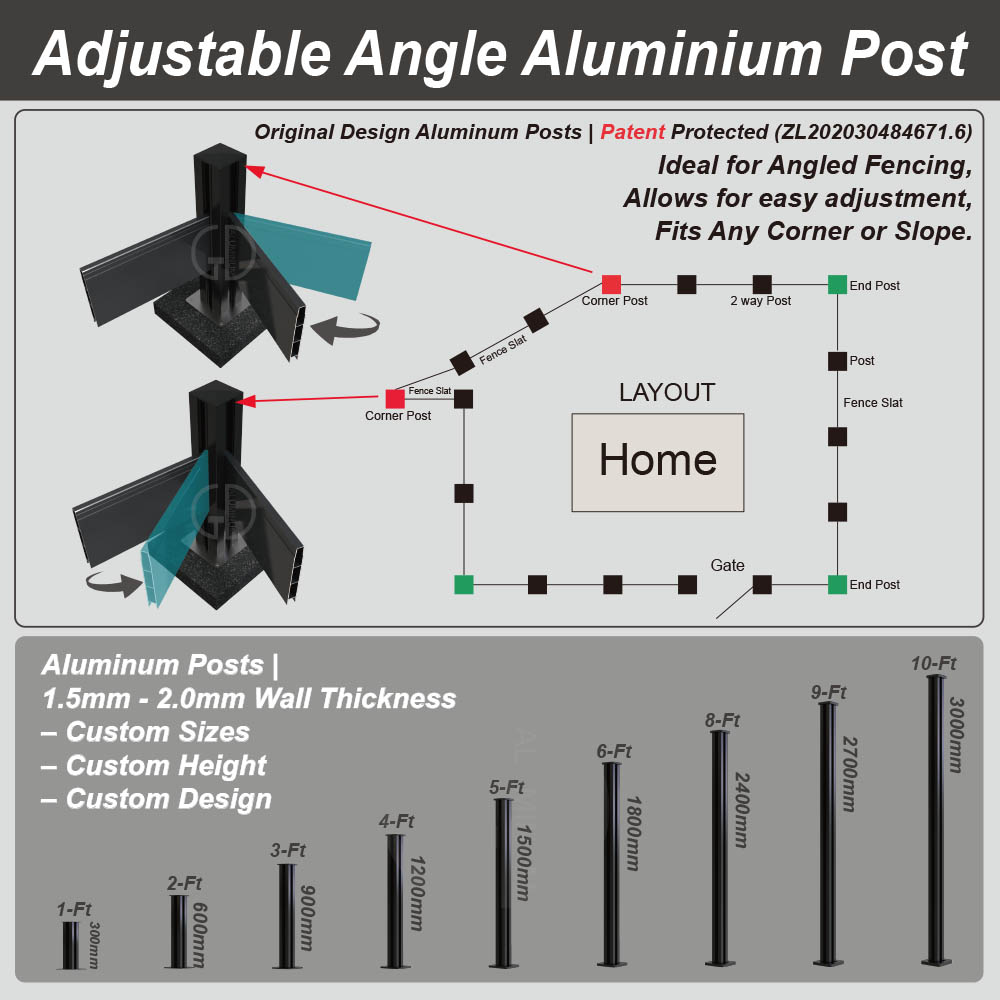
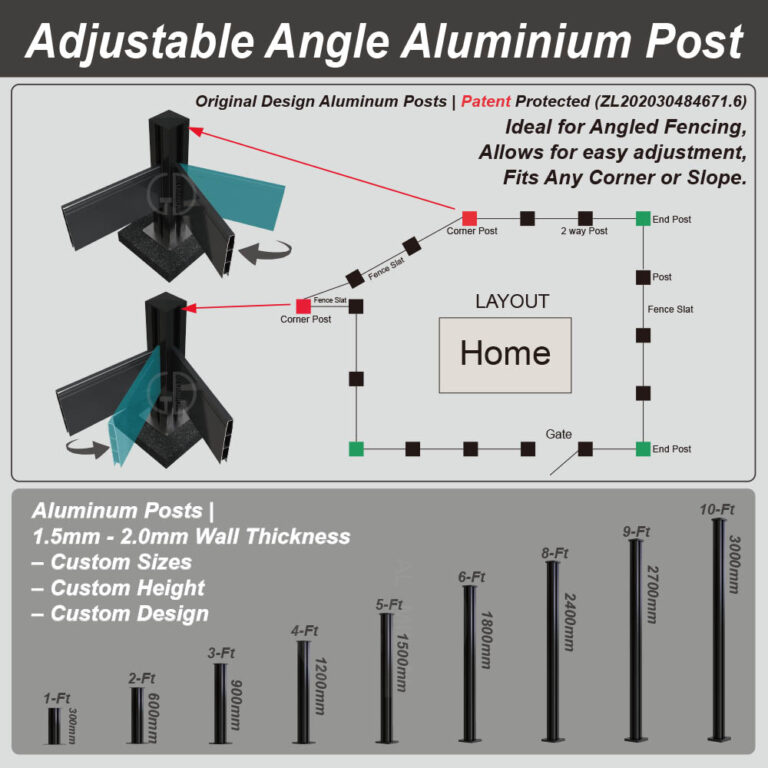
Standard fixed-base posts demand a perfectly level substrate. On sloped sites, limites curvos, or uneven concrete pads, the installer faces two options: shim the post and hope thermal cycling does not loosen it, or fabricate custom angled brackets on site. Both approaches add labor hours and create potential failure points at the connection. Our patented swivel post system (Patente chinesa ZL202030484671.6) adjusts from 0° a 90° at the base, allowing installers to follow terrain contours without field modification. Across multiple commercial deployments, we have measured approximately a 30% reduction in post-installation labor compared to fixed-angle alternatives on sloped sites.
For commercial projects, understanding post classification is essential before finalizing an order. Each post in a fence run serves a different structural role:Postagens de linha are the standard intermediate posts that carry panel sections on both sides. They handle uniform wind load and must match the panel height and spacing specification exactly. Undersized line posts are the most common cause of mid-span deflection in aluminum fencing.Postes de canto anchor directional changes in the fence line. They carry asymmetric loading—wind pressure on one face, tension from the adjoining panel on the perpendicular face—and typically require a heavier wall thickness or larger cross-section than line posts in the same run.Terminar postagens terminate a fence line at a wall, portão, or building. They carry the full tension load of the attached panels on one side only, creating a cantilever effect at the base connection. End posts should always be specified with the same or greater wall thickness as corner posts.Gate Posts support the weight and swing force of a hinged gate. They are a separate engineering consideration from fence-run posts and should be specified independently based on gate weight, width, and expected cycle frequency.Beyond classification, verify three base plate details before ordering postes de cerca de alumínio: whether holes come pre-drilled, whether the plate includes an internal drainage channel (standing water inside a hollow post freezes, expands, and eventually cracks the extrusion), and whether the post-to-base connection is welded or mechanically fastened—welded joints concentrate stress and are harder to replace individually when damaged.
Lista de verificação de auditoria de fornecedor: 4 Documents to Request Before Ordering Posts
- Mill Test Certificate for the alloy batch—Confirms 6063-T6 designation, composição química, and tensile test results. Without this document, you are purchasing on verbal assurance from someone who may not know what went into the extrusion billet.
- Cross-sectional drawing with wall thickness callouts—Verifies internal rib geometry, multi-chamber structure, and actual wall dimensions against the quoted spec sheet. A supplier who hesitates to share this drawing is hiding something about their die design.
- Salt spray test certificate (ISO 9227)—Documents coating durability with test duration, classificação de resultados, and coating thickness measurements from cross-sectional microscopy—not a surface gauge reading taken after the fact.
- Wind load test report naming the specific post profile tested—A laboratory document from an accredited body (Intertek, GV, TÜV) that identifies the exact assembly configuration you are purchasing, not a generic calculation or a test of a different product with similar dimensions.
Need detailed CAD drawings and structural calculation data for your project?
Contact our engineering team for aluminum fence post spec sheets, 2D/3D CAD files, and wind load calculation reports tailored to your specific post profile and site conditions.
Perguntas frequentes
What is the standard wall thickness for commercial aluminum fence posts?
Commercial and high-wind applications should specify a minimum wall thickness of 1.6 milímetros, with heavy-duty industrial perimeters at 2.0 milímetros. The required thickness scales with post height because wind loading creates a lever arm that increases non-linearly—a 2.4-meter post needs a proportionally thicker wall than a 1.2-meter post, even at identical outer dimensions. Residential-grade posts at 1.2–1.5 mm will not meet the structural requirements of commercial fencing codes in most jurisdictions.
Can aluminum fence posts be installed on a slope without custom metalwork?
Sim, if the post system includes an adjustable base connection. Fixed-angle posts require custom bracket fabrication or shimming on sloped terrain, adding labor and introducing potential failure points. Swivel post designs with 0° a 90° rotational adjustment allow the post to follow terrain directly. Our patent-protected swivel post has been used across sloped residential and commercial installations in Europe, Austrália, e América do Norte, typically reducing post-installation labor by approximately 30% on sites with grade changes.
How long do powder-coated aluminum posts last in coastal environments?
With a properly specified polyester powder coating—80–100 microns, chromate conversion pretreated, tested to ISO 9227 para 1,000+ hours—aluminum posts in marine environments within 5 km of salt water can deliver a service life exceeding 25 years without structural corrosion. Unlike galvanized steel, the 6063-T6 aluminum substrate is inherently corrosion-resistant: even if the coating is scratched through, the exposed metal forms a stable aluminum oxide layer rather than rusting. The limiting factor over decades is not the metal but the coating’s UV degradation, which is why AAMA 2604 compliance matters.
What is the cost difference between 6063-T5 and 6063-T6 aluminum posts?
The alloy price difference is typically 5–8% of the extrusion cost—a minor fraction of the total installed fence budget. What changes is the structural margin: 6063-T6 delivers approximately 43% higher tensile strength (215 MPa vs. 150 MPa) compared to 6063-T5. For a large-scale commercial installation, the cost of upgrading from T5 to T6 is recovered the first time a major storm does not require post replacement. When evaluating quotes, confirm the temper designation appears on both the quotation and the mill test certificate—not just the alloy number.
For independent verification of wind load testing methodologies applicable to fence assemblies, refer to the Intertek architectural testing and certification standards, which define the accredited protocols used in structural performance evaluations.