Design de portão de alumínio personalizado: 5 Verificações de engenharia comprovadas antes de aprovar desenhos
Design de portão de alumínio personalizado: 5 Verificações de engenharia comprovadas antes de aprovar desenhos
If you’ve ever signed off on a custom gate that sagged within a year, or paid to redraw a design that “couldn’t be built,” you know the price of the gap between renderings and reality. The fix is an engineering review that starts before the first extrusion order. This guide shows how custom aluminum gate design works inside our factory, and the five checks we run before production.
Neste guia:
Why stock gates fail on high-end projects · O 5 engineering inputs that define custom aluminum gate design · What the spec sheet must prove · Our drawing-to-fabrication workflow · Supplier audit checklist
Why Stock Gates Fail on High-End Projects
Catalog models cover standard widths and heights. On a 4.8 m driveway with a 1:12 declive, a stepped boundary wall, or a facade you cannot drill into, o “padrão” model stops fitting long before it stops looking right.
When we see a gate returned or reinforced on site, it is almost never an alloy failure. It is a fit failure: wrong hinge point, shallow post embedment, or a frame section too light for the leaf width. Those are design decisions, not material problems.
For architects and property owners, the lesson is simple. Buy the engineering, not just the drawing. A serious custom aluminum gate design comes with calculations, not only CAD files.
O 5 Engineering Inputs That Define Custom Aluminum Gate Design
Every custom aluminum gate design we produce starts from the same five inputs. If the brief is missing one, the gate will either cost too much or perform poorly.
1. Site geometry and clearances. Opening width, swing arc, declive, headroom, and the surfaces the hinges can physically anchor to. We take these from a site survey, never from a photo.
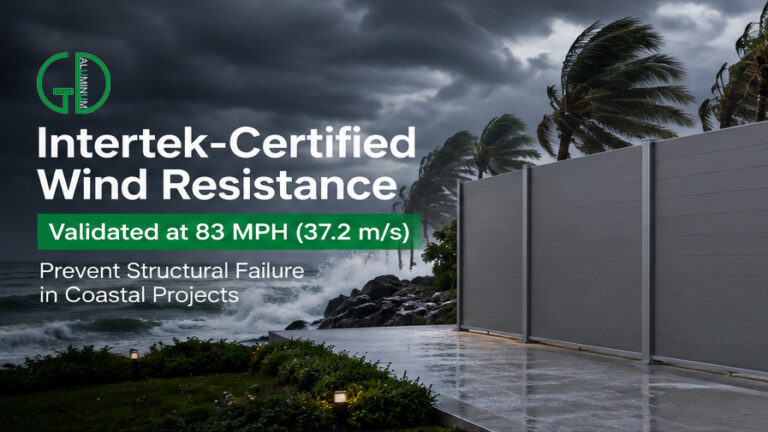
2. Wind exposure. A gate is a vertical sail. We calculate design wind pressure against local building codes, and for coastal or high-rise sites we design toward our Intertek-certified 510 N/m² envelope.
3. Automation and hardware. Motor torque, arm geometry, and lock type change the frame stiffness requirement. A sliding leaf twists differently from a swing leaf, and the frame must be engineered for the heavier load.
4. Finish and environment. Salt exposure, ultravioleta, and scratch risk decide between AAMA 2604 e AAMA 2605 grade powder coating. Coastal installs always get the higher grade.
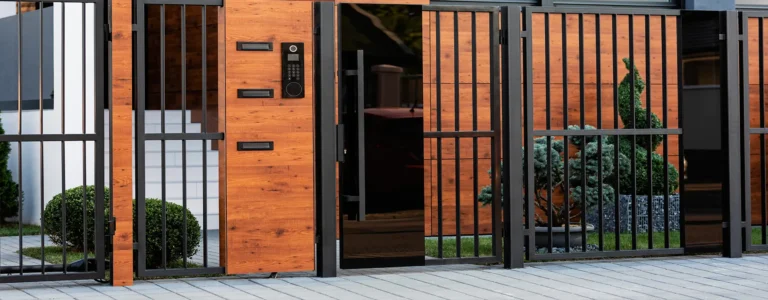
5. Security and access. Clear height, anti-climb detailing, and integration with intercoms or access control are decided in the design phase, because retrofitting them later weakens the frame.
What the Spec Sheet Must Prove: Liga, Wind Load, and Coating
A rendering tells you nothing about longevity; the spec sheet does. In custom aluminum gate design, the spec sheet is the real contract between buyer and fabricator. We build gates from 6063-T6 aluminum extrusions, the same alloy family used in structural curtain walling, because it holds yield strength while keeping profiles clean and weldable.
The second number to verify is a third-party wind load certificate. Our gate and fence systems are tested under dynamic simulation by Intertek and certified to 510 N/m², which covers typhoon-level exposure. The certification report is what we hand to structural engineers, not a marketing line.
Coating is the third proof point. Powder coating to AAMA 2604 ou AAMA 2605, applied at 80-100 mícrons, survives 2,000 hours of neutral salt spray testing. That is the difference between a gate that still looks new in year ten and one that chalks by year three.
From Drawing to Fabrication: Our Custom Gate Workflow
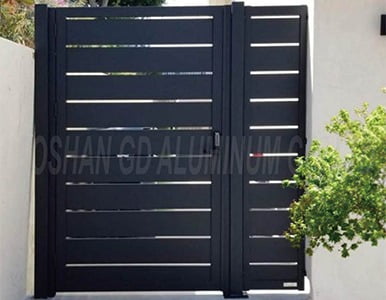
In our plant, custom aluminum gate design moves through four checkpoints: concept drawing, engineering review, extrusion and machining, then assembly and QC. Each checkpoint has a sign-off, so changes are priced before metal is cut, not after.
When we work with a client on a high-end residential or commercial gate, we always recommend a full-size sample of the leaf corner or hinge zone before mass production. A 30-minute sample review catches alignment, weld, and finish issues that no drawing review will ever surface.
This two-phase approach protects both sides. The client validates aesthetics and fit early, and we lock tolerances before the production run begins.
Commercial vs Residential: When Custom Design Pays Off
Residential projects justify custom design when the site has constraints: sloped driveways, limites curvos, or sightline rules. Commercial projects justify it on duty cycle, because a loading dock gate that cycles hundreds of times a day stresses the frame far beyond a residential gate. Either way, the custom aluminum gate design should document the duty assumption so the frame is never undersized.
One rule we use internally: if a gate will cycle more than 20 times a day, specify heavier hinge gussets and a stiffer leaf regardless of the render. Automation and high-frequency use expose frame weaknesses that hand-operated gates never reveal.
If you are weighing options, our guide to choosing an aluminum gate for your driveway or walkway covers the sizing logic in more depth. For wind engineering behind gate posts, veja nosso padrões de postes de cerca de alumínio com classificação de vento.
Lista de verificação de auditoria de fornecedor: 4 Documents to Request Before Approving Custom Gate Drawings
Before you approve any custom aluminum gate design, ask the fabricator for these four documents. A factory that cannot produce them is selling drawings, not engineering.
1. Certificado de teste de moinho para o lote de extrusão 6063-T6. Verifica a liga e a têmpera, não apenas o nome no folheto.
2. Wind load calculation or third-party test report. Check the test pressure and the standard used, and confirm the report covers the gate, not just the fence panel.
3. Coating certificate. AMAMA 2604/2605 compliance with the salt spray hours and film thickness stated in writing.
4. Weld procedure or joint detail for the hinge zone. The hinge zone is the most stressed point on any gate, and it deserves its own engineering detail.
Need a starting point? Nosso página de fabricação de alumínio personalizada explains the OEM/ODM process, and you can view the decorative aluminum art gate series in our product range.
Perguntas frequentes
How much does custom aluminum gate design cost compared to a stock gate?
Custom fabrication typically adds 20-35% over an equivalent stock gate, and the premium is concentrated in engineering and tooling, not material. For a gate that fits a constrained site and carries a certified wind rating, that premium usually pays for itself in installation savings alone.
Can a custom aluminum gate be automated later?
Sim, if the frame is engineered for automation from the start. We design hinge gussets and leaf stiffness to carry a motor’s torque, so buyers can install manual hardware now and automate later without re-fabricating the leaf. Confirm the motor’s arm geometry is noted in the drawings.
What finish lasts longest on an aluminum gate near the ocean?
AAMA 2605-grade powder coating is the top architectural grade, validated by 2,000 hours of neutral salt spray testing. For a coastal installation, specify 2605 with a film thickness of 80-100 mícrons, and match the hardware alloy to avoid galvanic corrosion.
How do I know a wind load rating is real?
Ask for the third-party certification report and check three things: the test pressure in N/m², the standard or simulation method, and whether the report covers your gate model. We supply our Intertek 510 N/m² report to any client before approval, because the certificate is the part that protects the project.