Система блокировки алюминиевого настила: 6 Критические проверки перед заказом
Колода, которая гремит, подъемы по краю или пряжки летом обычно связаны с одним решением, принятым на этапе предложения. Ан aluminum decking interlocking system is sold as a set of boards and clips, yet the behaviour of the finished deck is decided by profile geometry, gap allowance and how the boards are restrained at the ends.
We extrude and supply these systems for balconies, roof terraces and commercial walkways, and the same four questions come up on every project. This guide lists the checks we run before we release a deck package for production.
Most buyers compare price per square metre and finish colour. Those two numbers say nothing about whether the deck will stay quiet, drain properly and pass a fire inspection five years later.
What Does an Aluminum Decking Interlocking System Actually Lock?
Ан aluminum decking interlocking system does three jobs at once, and a system that only does one of them will show the weakness within a season. The first job is lateral restraint, keeping boards at a fixed spacing under foot traffic.
The second is vertical hold-down, which resists wind uplift on exposed terraces. The third is a controlled water path, so rain reaches the drainage plane instead of sitting in the joint.
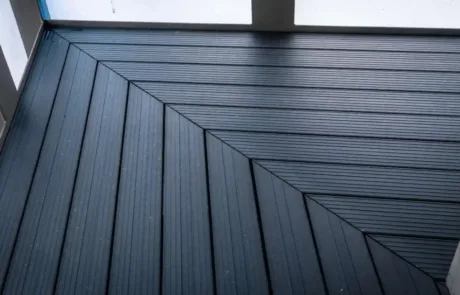
Concealed clips are the most common form of aluminum decking interlocking system, engaging a groove in the board sidewall. Face-fixed boards rely on visible screws, which restrain the board but interrupt the water path and the finish.
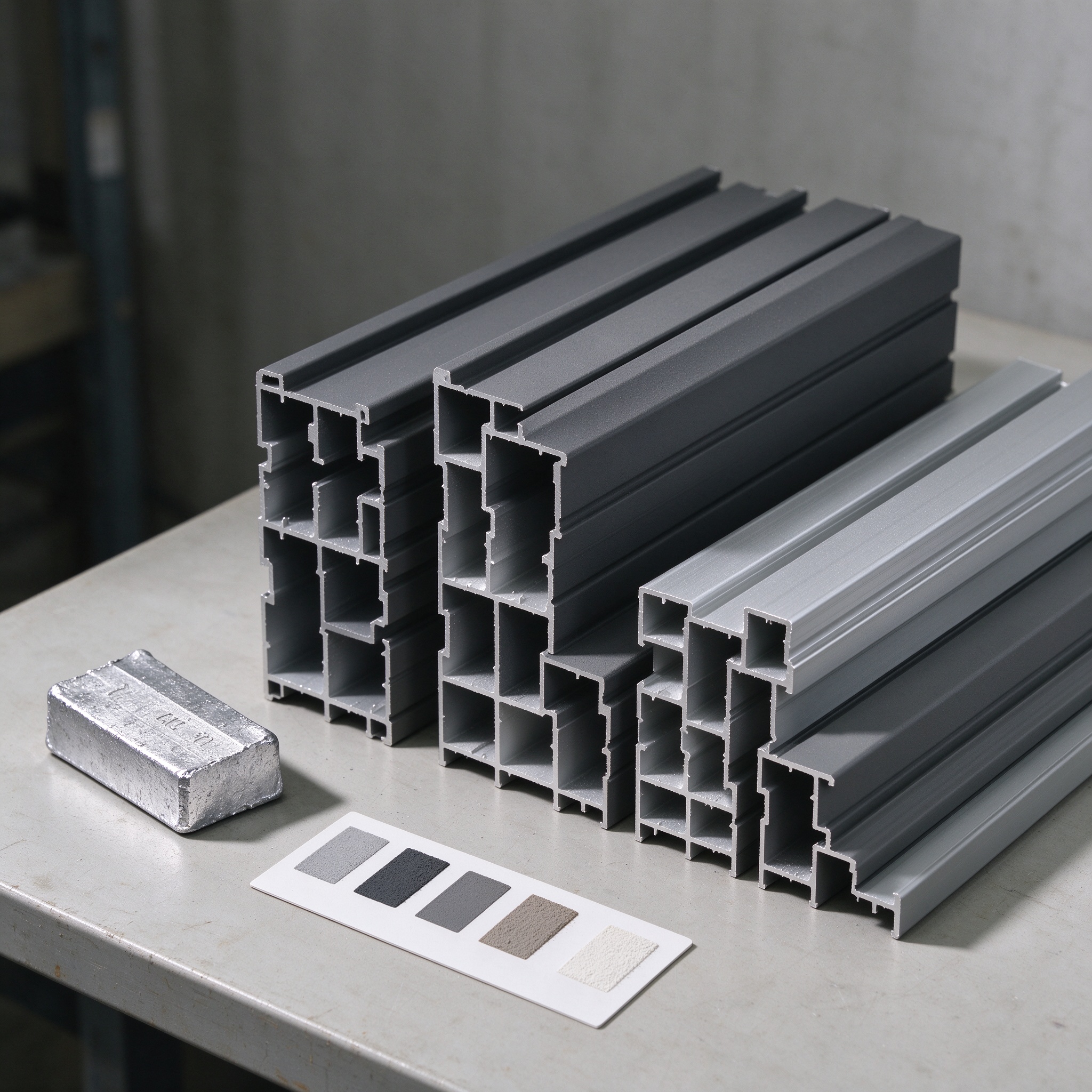
In our extrusion practice, the groove depth and the clip engagement are designed together. A clip that engages 4 mm into a groove cut for 6 mm will hold on the bench and release under thermal movement on a roof.
Where Do Interlocking Deck Systems Fail on Real Projects?
An aluminum decking interlocking system fails in four predictable ways, and none of them is visible at handover. The first is a deck fixed at both ends, which leaves the board no room to move and turns expansion into buckling.
The second is under-fastening. Crews shorten the clip count at the perimeter to save time, and the first storm lifts the edge boards that carry the highest uplift pressure.
The third is a blocked drainage path. Debris collects in the joist cavity, water stands against the board underside, and the fixings stay wet for weeks at a time.
The fourth is cut-edge corrosion combined with dissimilar metal contact. A dry-cut end left untreated, fastened with a galvanised screw into a coastal environment, is where the first white chalk appears.
How Do You Size Expansion Gaps in an Aluminum Decking Interlocking System?
Gap sizing is where an aluminum decking interlocking system earns or loses its reputation. For 6063 alloy the linear coefficient of thermal expansion is about 23.5 × 10⁻⁶ per kelvin, a figure quoted in standard mill datasheets for the alloy.
Use it directly: change in length equals length × coefficient × temperature swing. А 3 m board facing a 40 K swing between a cold install and a hot afternoon grows by 3 × 0.0000235 × 40, which is 2.8 мм.
| Board length | 30 K swing | 40 K swing | 50 K swing |
|---|---|---|---|
| 1.5 м | 1.06 мм | 1.41 мм | 1.76 мм |
| 3.0 м | 2.12 мм | 2.82 мм | 3.53 мм |
| 6.0 м | 4.23 мм | 5.64 мм | 7.05 мм |
Short boards hide the problem because the movement is small. Long boards and continuous runs do not, and that is where a gap set by eye at 2 mm in the morning becomes a buckle by July.
Per metre and per kelvin the movement is only 0.0235 мм, which is why the error survives inspection. Multiply that small number by run length and temperature swing, and it becomes the millimetres that decide the joint detail.
Set the gap at the installation temperature, then specify slotted or floating fixings at one end of each run. Never pin both ends of a board, and never assume the finish coat will absorb the difference.
Which Profile Details Decide Clip Retention and Wind Uplift?
Clip retention decides whether an aluminum decking interlocking system stays quiet after five summers. It is a function of engagement depth, rib geometry and the number of clips per board, and a deeper groove with a wider clip land spreads the load.
Joist spacing must come from the manufacturer span chart for that specific board, not from a generic rule of thumb. A board rated for 600 mm spacing will deflect visibly at 800 mm even when the clips are correct.
Wind uplift is the load buyers forget. Our decking assemblies are validated against the same 510 N/m² dynamic pressure benchmark we use for fence systems, so the perimeter fixing pattern is engineered rather than estimated.
Fastener grade matters as much as clip design. АИСИ 304 screws suit inland projects, while coastal and pool-deck environments call for 316 grade, and the two must never be mixed in one elevation.
How Do Fire Class and Drainage Interact With the Interlock?
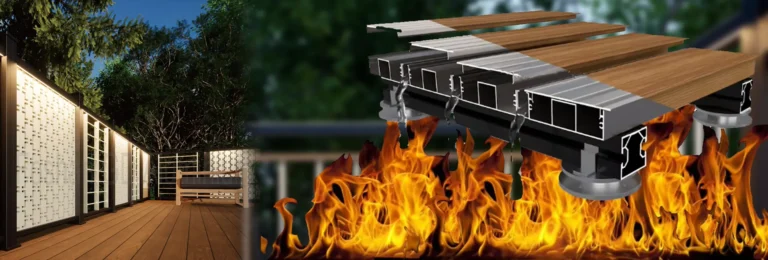
Fire classification and drainage are separate properties, and an aluminum decking interlocking system can be strong in one and weak in the other. В 13501-1 ratings such as A2-s1,d0 describe reaction to fire, not the performance of clips or fixings.
That distinction matters on high-rise balconies, where the specification may require a non-combustible class while the fixing pattern is still left to the installer. Наш Euroclass A1 and A2 systems are documented separately from the structural test data, и non-combustible aluminum decking guide covers the balcony case.
Drainage needs a fall and a path. A minimum fall of roughly 1 к 2 percent toward the outlet keeps water moving, and the interlock gap must align with the drainage channel rather than crossing it.
Where a deck sits over a habitable space, the waterproof layer sits below the boards and the interlocking system must not puncture it. Clips fixed through a membrane are the fastest way to turn a deck into a leak.
How Do You Verify the System Before You Order?
Bench-test an aluminum decking interlocking system before you release the full package. Order a sample board and a handful of clips, assemble two boards, and check how much lateral play remains at the joint.
Build a three-board mock-up at the actual joist spacing and leave it in the sun for a day. Measure the joint at the coolest and warmest point, then compare the movement with the calculation above.
Ask for the span chart, the clip pull-out data and the fire classification report for the exact board you are buying. A system that cannot supply all three is being sold on finish colour alone, which is why we publish АМАМА 2604 и 2605 coating data with every deck package.
Контрольный список аудита поставщика: 5 Documents to Request Before You Order
Deck packages are bought on drawings and delivered as extrusions, so the paperwork is your only chance to catch a mismatch. Request these five items before production starts, and check them the way a fence and decking factory audits its own extrusion lines.
- Board and clip datasheet with engagement dimensions: proves the groove and clip were designed as a pair, not sourced from two suppliers and matched on site.
- Span chart for the exact board profile: gives maximum joist spacing and cantilever limits, which is the number that decides deflection under foot traffic.
- Thermal movement and gap table: shows the manufacturer’s allowance by board length and installation temperature, so your gap detail can be checked against it.
- Fire classification report (В 13501-1 or local equivalent): names the tested assembly and the class achieved, and separates reaction to fire from structural performance.
- Coating and salt spray certificate: documents the AAMA 2604 или 2605 system and ISO 9227 часы, which is what a coastal warranty claim will be judged against.
Часто задаваемые вопросы
Is an aluminum decking interlocking system waterproof?
Нет, and an aluminum decking interlocking system is not meant to be waterproof. The boards and clips form a drainage plane that sheds water, while the waterproof layer belongs below the deck structure. Treat any claim of a waterproof interlock as a request to see the membrane detail.
How much gap should I leave between aluminum deck boards?
Enough to absorb the calculated thermal movement for your board length and temperature swing, which is around 2.8 mm for a 3 m board at 40 K. That figure applies to any aluminum decking interlocking system built on 6063 сплав. Many systems also need a visible drainage gap of several millimetres, so take the larger of the two numbers.
Can I install aluminum decking over an existing timber deck?
Sometimes, if the timber frame is sound, dry and capable of carrying the new span load at the required joist spacing. The interlocking system still needs its own drainage path and a fixing pattern that does not trap water against the old structure.
Why do my deck boards click when I walk on them?
Movement at a joint that was fixed too tightly, or a clip that is not fully engaged. Clicking usually means one end of the board is pinned while the other wants to move, so check the end fixings before adding more clips.
Send us the deck area, the joist layout and the fire class your project requires, and we will return a board schedule with clip counts and gap values for each run. Our team quotes samples and production in the same thread, so the mock-up and the order stay consistent.